By Dan Gephart, April 11, 2023

Long-time members of FELTG Nation recall Meghan Droste as an engaging instructor and writer, who could break down difficult subjects into easy-to-understand guidance. At the same time, she’d often leave this FELTG Newsletter Editor with an earworm or two.

Ms. Droste, now an administrative judge with the Equal Employment Opportunity Commission, will kick off Day 1 of FELTG’s upcoming Emerging Issues in Federal Employment Law event, presenting Avoiding Pitfalls: Advice from an EEOC AJ on Tuesday, April 18, 2023, at 10:30 am ET.

[The theme for Day 1 is Lessons Learned and we’ll also have presentations from former MSPB Member Tristan Leavitt and FELTG’s own Joseph Schimansky. Check out the full agenda. Register for one session, one day, the whole event or any combination of sessions – it’s up to you.]

We recently caught up with Ms. Droste to discuss her career transition and what she plans to cover in her session on April 18.

DG: As a practicing attorney, you were very familiar with the EEO process. Did anything surprise you or was there anything about the process you didn’t realize until after you became an administrative judge?

MD: When I first started it was very interesting to see all of the work that is done “behind the scenes” — everything that AJs have to juggle that the parties don’t see. But I think the most surprising thing was the number of self-represented, or pro se, complainants who we see in the Washington Field Office. As a complainant’s representative I of course did not have any involvement in those types of cases, and even when I represented a Federal agency, I often encountered representatives on the other side. The process is meant to be accessible for self-represented complainants and it has been very interesting to see just how many there are.

DG: What is the most common misunderstanding about the EEO process?

MD: I think one of the most common misunderstandings, from both complainants and agencies, is an assumption that the hearings process is informal and not as serious as litigation in Federal court. AJs don’t wear robes or sit in courtrooms, but we still issue orders and set schedules that the parties have to abide by. It seems that some parties don’t understand that and think that deadlines are optional or that they can ignore their obligations that we set out in our orders or are in the EEOC’s Management Directive 110.

DG: What’s your advice to parties who are new to the EEO process on the importance of the initial conference?

MD: It is so important for the parties to be prepared for an initial conference (IC). By the time I hold an IC, I have reviewed the Report of Investigation, the parties’ Preliminary Case Information submissions, and anything else that they have uploaded to the Public Portal/FedSep; I expect the parties to have done the same and to be familiar with their case. The parties should be ready to address all of the topics outlined in the Acknowledgment Order and answer any questions I have for them about the record or their discovery needs. If they aren’t prepared, it slows down the IC and can result in a party waiving its right to raise an issue or object to something that I cover during the IC.

DG: You will be discussing the importance of civility in the EEO process at Emerging Issues in Federal Employment Law. Can you provide an example where lack of civility negatively impacted a party’s position in settlement or litigation?

MD: One way that this comes to my attention is when parties are filing a motion for an extension or a motion to compel. I generally do not see the parties’ interactions with each other, but when it comes time to file a motion that requires the party to note the opposing parties’ objections to the motion or to refer to the parties’ discussions about discovery, I see copies of correspondence between the parties as exhibits.

It’s easy to see when the parties are being civil to one another and when they are not. It’s also easy to see how, as the parties become more heated, they are less willing to work with each other to resolve routine issues. This impacts the issue they are filing the motion for and can make any later settlement discussions more difficult, if not impossible, as each side digs into their own positions and are unwilling to compromise.

DG: Agencies often miss the mark in their pleadings. What’s the most common problem with pleadings and how do you suggest that problem be fixed?

MD: Two things come to mind right away, and both are easy for agencies to fix. The first is exceeding the page limits for motions or otherwise failing to follow the requirements I set out in the Case Management Order (CMO). I remind the parties during every IC to review the CMO thoroughly because each AJ does things a little differently. Despite this, I can always tell when a party has failed to do so, and it can have a real impact for them. For example, if a party exceeds the page limit, I stop reading the motion at the last allowable page. I don’t give any consideration to any argument that comes after the page limit. The second common problem is allowing the agency’s arguments to creep into the statement of facts. The statement of facts should be, as it sounds, just the facts. An agency loses some credibility with me in the summary judgment process if it tries to spin the facts rather than presenting them without argument.

Have your own questions for Judge Droste? Register now for Emerging Issues in Federal Employment Law. Gephart@FELTG.com

By Bob Woods, April 4, 2023

The EEOC’s Office of Federal Operations (OFO) recently published an article discussing the “offer of resolution” (29 C.F.R. 1614.109(c)), which they refer to as an “often overlooked tool for agencies to settle EEO complaints.”
For those of you who are relatively new to practice before the EEOC, you may not realize that this “tool” has been available since 1999, when it replaced the “Offer of Full Relief” settlement option (previously available pursuant to then-29 C.F.R. 1614.107(h)).

The principal difference between these tools is that if an agency “offer of resolution” is rejected and the EEOC subsequently awards a lesser remedy than was offered, the agency is relieved of paying costs and attorney fees incurred after the offer acceptance period, whereas if an agency’s offer of “Full Relief” was rejected by a complainant, the agency could dismiss the complaint.

At that point, the complainant could seek review from the EEOC. If the EEOC agreed that the offer contained all of the remedies to which the complainant would have been entitled if the complainant prevailed on the allegations of discrimination, they would sustain the dismissal. See Henderson v. Navy, EEOC Appeal No. 01984538 (EEOC 1999).

The premise of this remedial provision was that it was unnecessary to adjudicate a complaint if the agency was willing to provide full relief. However, with the advent of compensatory damages, provided for by the Civil Rights Act of 1991, it became increasingly difficult to determine whether the Agency’s offer of compensatory damages would be considered enough to constitute “Full Relief.” As a result, the EEOC eliminated the “Offer of Full Relief” from the list of reasons for dismissal provided in 29 C.F.R. 1614.107 and amended the provisions of 29 C.F.R. 1614.109 to include the provision for “Offers of Resolution.”

Fast forward a quarter of a century. The OFO notes that this tool is underutilized and suggests that its use should be revisited by agencies. This suggestion provides an excellent opportunity to review the topic of settlements in EEO cases, something I’ll be covering in the April 12 virtual training Drafting Enforceable and Legally Sufficient Settlement Agreements.

My colleagues at FELTG asked me the below questions and my answers follow:

What are your thoughts about the use of the Offer of Resolution?

I agree the offer of resolution is probably underutilized, but I recognize it can be difficult to calculate and may involve more than an agency might be willing to offer. These offers, in particular, require a thorough analysis of the evidence and the existing EEOC awards of remedies provided in similar cases. This means the agency must ask the complainant for specific evidence to support their claim for compensatory damages and then use that evidence to try to determine its validity and how it will be assessed by the EEOC.

Offers of resolution should be made anytime the agency makes this thorough assessment and believes they are offering full relief or in situations where they believe they have offered full relief but the complainant and her/his attorney refuse to accept the offer and continue to demand additional compensation. In such cases, the agency has nothing to lose in making the offer or resolution. If the EEOC awards the same or lesser relief, the agency obtains some relief in the form of lower reimbursements for costs and attorney fees incurred after the rejection of the offer of resolution. Alternatively, if the EEOC awards greater relief, the agency is in no worse position with regard to reimbursements for costs and attorney fees than it would have been had it not made the offer of resolution. The OFO article describes the intent of the provision “ … is to encourage agencies to avoid costly EEO administrative litigation and to make complainants consider whether continuing with the EEO process would be in their best interests.”

Can you discuss the confidentiality aspect of settlement discussions?

It’s well settled by EEO law that settlement negotiations are confidential and privileged. In fact, the same holds true in the ADR process as well as in judicial proceedings and before many other adjudicative bodies. This includes settlement proposals made or discussed, as well as statements made during the course of negotiations. The reason for this policy is to enable the parties to speak freely when exploring potential options for resolution without fear of those discussions being used against them in future proceedings/litigation. MD-110, Chapter 2, Section IX(C).

Some Federal supervisors or leaders see settlement as indicating a flaw in a case, or as taking the easy way out. What would you like those people to know about settling Federal sector employment disputes?

While this sentiment is somewhat understandable, it often misses legitimate interests involved in settling a case. Every EEO complaint (starting at the pre-complaint phase) deserves an honest, open-minded assessment of the particular circumstances of the concerns/allegations presented. Supervisors and leaders need to be educated on the process generally and on the pros and cons of settlement of the particular case. It may be there is a “flaw in the case.” It may be there is evidence of discrimination or there may be weaknesses in the evidence supporting the management action, including issues of credibility of witnesses. In fact, if management did do something wrong, whether or not it constitutes discrimination, it needs to be corrected as quickly and as thoroughly as possible. Even in cases that don’t appear to have these “flaws,” there may be very good reasons to resolve the matter via settlement.

As we often teach, the best outcomes occur when resolution is freely arrived at by all parties. There are no guarantees in litigation. Early resolution often results in a more amicable return to the working relationship and returns the parties to where they can focus on mission/career. It also enables them to get an unpleasant experience over with before the case can swallow their lives. Settlements do not require any admission of fault. Additionally, the earlier the resolution, the lower the direct and indirect costs.

Are there certain types of cases you would recommend not settling. If so, why?

In my opinion, settlement should be seriously considered/explored in most (maybe even all) cases. Once the circumstances and evidence have been thoroughly reviewed, the main question will be what, if any, resolution terms short of litigation might satisfy the interests of both parties. Typically, agencies try to support the prerogatives of supervisors and will first explore alternatives that provide that support. Assuming a thorough review, I would not recommend settling any case where the evidence supports the agency position and the complainant refuses to compromise on their demands for relief that are disproportionate to the bounds of that analysis. Likewise, I would oppose settling on terms that exceed that to which the complainant would be entitled if they prevailed on the allegations of discrimination.

Instead of trying to capture the types of cases for which I would not recommend settlement, I’d prefer to identify some terms that I would argue are inappropriate. For example, there are times when a supervisor just wants to be rid of a “bad employee” and is willing to agree to terms that would make this employee someone else’s problem (e.g., a reassignment or accepting a “clean paper” resignation). If this is truly a “bad employee,” it is the supervisor’s responsibility to hold them accountable and not let them move on. To accept such terms would be a disservice to both the gaining supervisor/activity/agency and to the taxpayer. It also allows the “bad employee” to continue their misconduct or unacceptable performance in the new environment. Likewise, a settlement agreement should not be used to shield a bad management official. If the evidence suggests wrongdoing on the part of management, corrective action is appropriate. Failure to hold management accountable, like failure to hold the “bad employee” accountable, sends a bad message to the workforce, violates the agency’s legal obligations, and enables the manager to continue to engage in similar conduct.

What questions do you have for me? Join us on April 12 for the answers. Info@FELTG.com

By Dan Gephart, May 27, 2923

Michael Wolf, Director, Collaboration and Alternative Dispute Resolution (CADRO)

In the first of this two-part article, we talked to the Federal Labor Relations Authority’s Michael Wolf, who is director of the Authority’s Collaboration and Alternative Dispute Resolution (CADRO) program about that program’s success. [Editor’s note: Visit here to learn more about CADRO and its services.]

Wolf described CADRO’s style of mediation as “situational” as opposed to “facilitative or evaluative or some other label.” The key, per Wolf, was that the “parties define success.”

We wondered how CADRO’s approach applied to agencies trying to resolve disputes internally. [For more on settling disputes, join FELTG on April 12 for Drafting Enforceable and Legally Sufficient Settlement Agreements.] We caught up to Wolf in between mediations and picked his brain on this important topic.

DG: What do you think is the biggest obstacle to resolving disputes?

MW: It depends. I realize that is not really an answer, but there is no other simple response that is also accurate. Most disputes we see in CADRO erupt from a set of unique causes, characteristics, and obstacles to resolution. From the standpoint of a third party who has no stake in the outcome, we help party representatives identify their obstacles and then help them adopt what they believe to be the most effective way to overcome those obstacles. This approach tends to result in parties that are more invested in making the outcome successful when compared to an outcome imposed by an outside source of authority such as a judge or arbitrator.

DG: What physical environment best creates an atmosphere for successful mediation?

MW: With rare exception, it is best for the physical environment to enable the mediator and participants to be free of unnecessary distractions, engage with an appropriate level of confidentiality, communicate effectively, utilize joint and separate sessions, consult with sources of information and authority when necessary, and be able to fulfill external responsibilities when required.

  • The location should be reasonably available and accessible.
  • Cost should not be a factor in whether a party is adequately represented.
  • The space should not create a perception of favoritism or bias.
  • The need to work outside of “normal” business hours might be a factor.
  • No party should feel unfairly disadvantaged by the physical environment, and it should be compatible with the mediator’s style, methods, and skillset.

I’m sure there are other considerations, but these are what immediately come to mind. I view available options based on five potential methods of engagement:

  • Synchronous and in-person
  • Synchronous and remote
  • Asynchronous and in-person
  • Asynchronous and remote
  • Hybrid – a combination of synchronous and asynchronous, in-person and remote

Each of these methods of engagement give rise to a different set of considerations concerning the physical environment. For example, if one or more participants is expected to engage remotely, the impact of differential technology skills, equipment, support, and access could affect both process and outcome of the mediation.

DG: You’ve been an advocate for the appropriate use of technology in mediation.

MW: I’ve been an advocate for the appropriate use of technology in mediation since at least the late 1990s when I was the FMCS Director of Mediation Technology Services. Today, CADRO mediation and settlement conferences would not be possible without a very heavy reliance on technology and remote engagement, both synchronous and asynchronous. I am not a believer in the use of technology to repair fractured relationships, but I have found it highly effective when used appropriately to mediate labor disputes.

At the same time, I tend to be “old school.” I prefer in-person engagement for disputes that are complex, serious, and consequential. But I also recognize that in-person engagement can enable disputants to misunderstand each other as well as understand each other. At times, in-person engagement can cause a disputant to feel threatened and therefore become defensive, maybe misinterpret what is said and done, and become a barrier to success.

Sometimes mediators can control the physical environment. Other times, we have more control over the factors that impact and result from the physical environment. A skilled mediator should be able to spot the issues on the fly and make necessary adjustments when needed.

DG: Can you name a few steps that someone in a dispute can do to bring two sides together – even if they are on one of the sides?

MW: Let me start with a few of the things I suggest that person should not do. They should:

  • Not pretend to be neutral if they are linked to one of the disputants.
  • Not try to determine or shape outcome.
  • Do their best to not be influenced by judgements or assumptions about the disputants or their issues.
  • Avoid the urge to offer advice (except about process).
  • Not try to save either disputant from themselves.
  • Actively avoid shifting the balance of power between disputants.
  • Not try to shape the disputants’ “truth.”
  • Avoid becoming so frustrated that they feel compelled to adjudicate the matter.
  • Not reveal matters shared with them in confidence.

Above all else, “do no harm.”

Now a few ideas about what they might do to help. First and most importantly, listen actively! Second, help them agree on a problem statement that is in the form of a question to which they both seek the answer. If they can’t agree on the question, it is unlikely they will agree on an answer. Jointly attacking the question can also help them avoid attacking each other. Third, help each person first explore separately and then share jointly why they care so much about the answer to that question. Write down the reasons they care (bullet list, not long paragraphs). Help them compare and contrast what they care about to see what their lists have in common. Generally, they will find it easier to agree on solutions if they share a common list of reasons why they care about the answer to the question.

Fourth, facilitate joint brainstorming of possible answers to the question. Encourage both to offer at least several ideas. The more the better. Get them to think outside the box. Discourage criticism of each other’s ideas. Try to write down every idea, even the ones that seem wacky. Encourage them to build on each other‘s ideas. Then discover the ideas that rise to the top and help them explore whether one or possibly a combination of ideas might be worth trying.

If they seem to agree on one or more ideas as a path forward, help them develop an action plan to implement the ideas. Follow up in several days and then again in several weeks. Help with any operational issues. Refer the matter to someone with expertise and experience if necessary.

Gephart@FELTG.com

By Deborah J. Hopkins, March 15, 2023

A recent MSPB nonprecedential decision has me scratching my head, as the outcome appears to go against over 40 years of case precedent. I wrote about the facts of the case in a previous newsletter article, so if you’d like the specific details please check that out. A quick recap though: The agency removed an employee based on three charges: (1) lack of candor; (2) disregard of directive; and (3) unauthorized absence. The MSPB only sustained charge 2, disregard of directive, because the appellant did not follow appropriate leave request procedures.

Because the agency only proved one of three charges, the Board mitigated the removal to a 7-day suspension. That may not sound odd to you, but here’s where I’m stuck: if you look at Board’s view of the Douglas factors analysis on pages 9-10 in the case, the appellant “was previously reprimanded and served a 3-day suspension for failure to follow the agency’s leave procedures.”

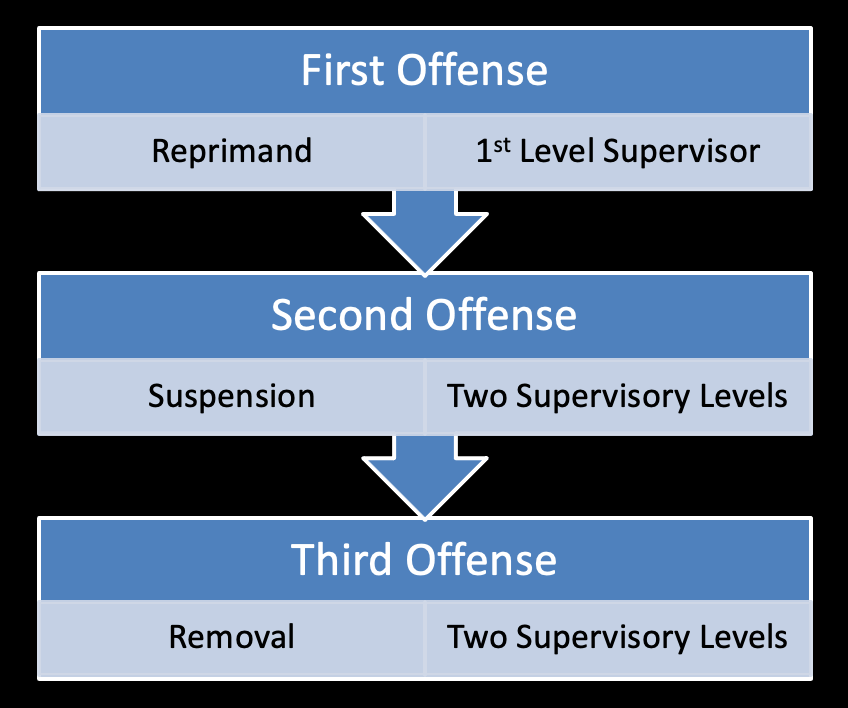
A principle that has been around for longer than the Civil Service Reform Act, progressive discipline stands for the proposition that for minor misconduct, Federal employees are generally given a “three strikes and you’re out” opportunity to learn from conduct-based mistakes. Progressive discipline, which we’ll discuss in more detail during MSPB Law Week March 27-31, typically looks like this:

  • First offense of misconduct: Reprimand
  • Second offense of misconduct: Suspension of 1-14 calendar days
  • Third offense of misconduct: Removal

Progressive discipline is not mandatory, most recently confirmed during OPM’s discussion of its updated regulations at 5 CFR §752.202.

There are times agencies remove an employee for a first offense (see, e.g., Pinegar v. FEC, 2007 MSPB 140), and there are times they give more than three strikes – sometimes a lot more (see, e.g., Blank v. Army, 85 MSPR 443 (2000)). And that is absolutely up to the agency. But past discipline has almost always been a significant aggravating factor, and for over four decades the Board has generally upheld removals for a third offense of any misconduct. See, e.g., Grubb v. DOI, 96 MSPR 361 (2004).

If the Board were to follow its own precedent in the current case, the agency should have received penalty deference and the Board should have upheld the removal. Instead, the Board found other factors to be mitigating:

  • The appellant worked for the agency for six years and did not have any performance problems during that time.
  • The appellant was not a supervisor.
  • The appellant contacted the agency “to inform his supervisor that he would be absent, albeit not in the way in which he was instructed.”
  • The appellant claimed he and his wife were having relationship troubles.
  • The appellant claimed he was experiencing pain because of a disability.
  • The agency’s table of penalties recommended a “5-day suspension to removal for a third offense of failure to request leave according to established procedures.”

If removal was appropriate according to the table of penalties, why did the Board mitigate?

I will admit, proving only one specification of one charge does make one consider whether the penalty is unreasonable; in essence the agency only proved a third of its case. That said, because of the weight past discipline usually holds, I am a little surprised the Board did not defer to the agency’s penalty. I wonder if the outcome would have been different if there was language in the decision letter that any charge standing alone would warrant removal? See, e.g., Sheiman v. Treasury, SF-0752-15-0372-I-2 (May 24, 2022)(NP).

This is one of the few cases under this Board where a Member dissented from the majority; Tristan Leavitt noted a dissent but without opinion, so it’s anyone’s guess as to why. Perhaps it’s for the very reason outlined above. Ortiz v. USAF, DE-0752-22-0062-I-1 (Jan. 25, 2023)(NP).

At first I was thinking this might be an outlier, but two subsequent cases have seen the same mitigation despite of past progressive discipline: Spivey v. Treasury (IRS), CH-0752-16-0318-I-1 (Feb. 15, 2023 )(NP) and Williams v. HHS, DC-0752-16-0558-I-1 (Feb. 25, 2023)(NP). Read on for Bill Wiley’s take on these cases and on why agencies discipline at all. Hopkins@FELTG.com

By William Wiley, March 15, 2023

So you just read FELTG President Deb Hopkins’ article about Ortiz v. Air Force, DE-0752-22-0062-I-1 (Jan. 25, 2023) (NP). The decision is significant only because it is very unusual (some might say “weird”) for the Board to impose a second suspension after a misbehaving employee has already been reprimanded and suspended without his learning to obey agency rules.

Another recent decision raised this same issue. The Board mitigated a removal to a 10-day suspension even though the agency had previously suspended the employee for five days for the same type of misconduct. Spivey v. Treasury (IRS), CH-0752-16-0318-I-1 (Feb. 15, 2023) (NP). Similar to Ortiz, one of the charges brought by the agency in Spivey failed on appeal and the agency “never stated that it desired that a lesser penalty be imposed if only one of the two charges was sustained.” By not stating in the decision memorandum what the penalty would be if fewer than all the charges were sustained, if one or more charges is not sustained on appeal, the deciding official, thereby, allows the Board to independently assess the Douglas Factors and select a penalty. See LaChance v. Devall, 178 F.3d 1246, 1260 (Fed. Cir. 1999).

This second-suspension mitigation highlights one of the great unanswered existential questions about the Federal workplace: Why do agencies discipline misbehaving employees? Suspending an employee for misconduct requires the agency to expend significant resources:

  • What happens to the employee’s work assignments during the suspension? Are they reassigned to hardworking coworkers who have to bear that extra burden? Must the supervisor bring in an outside contractor to do the work? Or does the employee’s work simply not get done during the duration of the suspension?
  • Separate from devoting resources to the suspended employee’s workload, there’s the cost of defending the disciplinary action. Career Federal employees have a plethora of ways to challenge a disciplinary action: administrative grievances, union grievances, EEO complaints, complaints to the US Office of Special Counsel, complaints to the Department of Labor related to veterans’ USERRA rights, MSPB appeals if the discipline is significant, etc.

Given that there can be a considerable cost to an agency when it suspends an employee, and given that an agency usually doesn’t expend resources without some gain in return, what is the benefit that the agency hopes to attain in exchange for a misconduct suspension? Two possibilities come to mind:

  • The agency hopes to motivate the employee to obey workplace rules. Behavioral psychologists call this technique for controlling behavior “negative reinforcement.” The theory is that by suffering pain (physical, mental, financial), the individual will learn to avoid that same pain in the future by refraining from engaging in the behavior that resulted in the pain. Cats sit on a hot stove only once. A child may learn acceptable social behavior as a result of the pain of isolation by being told to sit in a corner. In theory, a Federal employee deprived of part of a paycheck by a suspension will refrain from engaging in the misconduct that resulted in the monetary loss. It’s fair to say that the primary reason agencies suspend employees is to “correct behavior.”
  • Is there some element of just plain old retribution in workplace discipline? An eye for an eye, a tooth for a tooth. You stepped on my foot; I’m going to stomp on yours. You caused me to suffer (by breaking a workplace rule), I’m going to make you suffer (by suspending you without pay) in retribution. Frankly, I would hope that this punishment-for-the-sake-of-punishment, separate from a desire to correct behavior, is not a desired “benefit” for an agency when it suspends an employee. However, when I look at how agencies have handled disciplining employees over the years, and how MSPB has validated those actions, I’m left with a belief that there is something beyond correcting behavior that motivates agencies to suspend.

If we accept that the primary objective of an agency suspending an employee is to correct behavior, then the Board’s mitigation to a second suspension in Ortiz raises a series of fundamental questions:

  • If the agency’s initial suspension of three days did not motivate the employee to abide by workplace rules, what makes the Board think that a second suspension of seven days will teach the employee that breaking rules is to be avoided? In practice, a seven-day suspension is only five workdays, two workdays of lost pay more than the initial three-day suspension. Is the Board thinking that those extra two days of lost pay will cause the employee to begin to obey the agency’s rules even though the first suspension did not?
  • How long should an agency have to tolerate a disobedient employee in its workforce? If these extra two days of lost pay do not result in the employee becoming obedient to the agency’s rules, is MSPB suggesting that another incident of this employee disregarding a directive should result in a suspension of an additional two or three more workdays of pay? What evidence is there that incrementally increasing the length of a suspension might eventually get the employee to obey the agency’s rules?

Perhaps the agency could have done more to protect itself from a mitigation. Not only did the deciding official not testify as to the penalty that would have been imposed if only one of the three charges had been sustained, but the agency’s own table of penalties indicates that a suspension is within the range of appropriate penalties for a third offense — “five-day suspension to removal.”

In Spivery, the table of penalties also allows for a suspension for a third offense. Effectively, agencies that have suspensions within the range for a third offense in their penalty table are acknowledging that a Federal employee who violates workplace rules may remain a Federal employee indefinitely.

There is a significant philosophical question in all of this, one that has not clearly been addressed. Why should agencies discipline employees? I would offer three plausible reasons and encourage agencies to adopt one, then clearly incorporate that into agency discipline policies:

  1. Suspensions are intended to correct behavior. If this is the agency’s objective, then the discipline policy should state it clearly. If the agency uses a table of penalties, then it should incorporate the three-strikes rule for guidance: reprimand, suspend, then removal. If a single suspension does not correct the employee’s behavior, there’s no evidence that a second or third suspension will.
  2. Suspensions are intended to punish. If this is the agency’s objective, then the discipline policy should leave room for more than one suspension, state in what situations more than one suspension would be reasonable, and then be prepared to have any removal mitigated to another suspension. The agency also should be prepared to continue the employment of individuals who repeatedly do not obey workplace rules and expend the resources necessary to do that.
  3. Suspensions have no place in a modern Federal workplace. This is the philosophical position adopted by a number of private sector companies. It is based on the belief that in a mature workforce, employers should not have to inflict pain on employees to get them to obey rules (and the employer should not have to bear the expense and inconvenience of a suspension).

Here’s one way the third option works. The first time an employee engages in misconduct, the supervisor tells the employee in writing that he has violated a workplace rule and that he should adhere to all rules in the future. This notice would be analogous to a reprimand in the Federal system. After notification, if the employee again violates a rule, the supervisor informs the employee of the rule violation and sends the employee home with pay for a day to contemplate whether he is willing to adhere to the company’s rules. If after this opportunity for contemplation the employee again violates a workplace rule, the supervisor offers the employee the opportunity to resign. If he refuses, the supervisor fires the employee. No punishment of the employee, no suspension-harm caused to the employer. Just the civil no-fault resolution of an inability to correct behavior situation.

Our civilization has evolved beyond the indentured servitude and physical bondage of earlier generations of our work forces. We no longer publicly flog or use a pillory with indentured servants who do not work hard enough. We are no longer in the early days of the last century when blue collar employees were seen as a lower class of citizen, beholden to and under the absolute control of their upper-class employers. The modern workplace is an egalitarian organization of knowledge workers with many flexibilities and employment options that were unheard of just a few decades ago.

Our Federal civil servants are getting older. Over the next few years, we can expect a large number of retirements from government service, with those senior citizens being replaced by younger workers who expect to be treated with respect as human beings rather than being forced and coerced into performing their jobs.

Perhaps, it is time for our management approach in the Federal government to evolve beyond discipling and punishing by suspending misbehaving employees, and instead focus on filling the civil service with individuals who follow directives without the need for pain. Wiley@FELTG.com

Join FELTG for MSPB Law Week:

By Barbara Haga, March 13, 2023

I enjoyed putting together the columns on clean record agreements so much that I thought we should follow that thread. This month, we look at things agreed to in settlement agreements that were ruled to be illegal and resulted in the MSPB overturning the settlement. These types of provisions fall in the “mutual mistake” category. Sometimes, there is a lot more to these agreements than back pay and attorney fees. This time we are going to look at leave issues.

Crediting Leave. In Franchesca V. v. Department of Veterans Affairs, EEOC Appeal No. 0120170632 (Mar. 2017), the complainant filed an age discrimination and reprisal claim.  She retired while the complaint was being processed. A settlement agreement was ultimately executed to resolve the complaint. The agreement said, among other things: “The Agency will, within 60 days of execution of this Agreement initiate restoration of the necessary amount of sick leave (approximately 606 hours) so Complainant retires with a balance of one year [in addition to her other years of service].”

The agency immediately ran into problems executing this portion of the agreement. The payroll office (DFAS, outside of VA) said it was a violation to grant this amount of leave under these circumstances. The agency’s servicing HR office intervened. Finally, the payroll office processed it and submitted the corrected record to OPM.

This lengthy process resulted in the complainant alleging a breach of the agreement, which escalated the matter to the agency HQ. They requested review of the matter, which included the following:

Complainant retired with 29 years and 4 months in service. The OGC staff attorney wrote that the intent of the sick leave restoration provision was to round up Complainant’s service to the next full year for retirement purposes. She wrote that when she negotiated the settlement agreement, she did not know this type of provision was frowned upon and considered an inappropriate use of retirement benefits. The OGC staff attorney wrote that DFAS made it clear that since Complainant never used 606 hours of sick leave, the Agency was asking to credit her more sick leave than she earned, which was not possible. Referring to the settlement negotiations, she wrote that she thought everyone assumed that Complainant would have spoken up if the Agency was offering the “restoration” of leave she never took.

After reviewing the information and consulting with the Department of Justice, the VA’s benefits and leave administration expert determined the provision was not just frowned upon but a violation of the law. The agency could not credit sick leave in excess of what the employee would have earned during her career.

Administrative Leave. In McDavid v. Army, 46 MSPR 108 (MSPB 1990), the appellant was found to be medically disqualified from flying. He was removed from his supervisory pilot position effective July 23, 1987.  McDavid appealed the removal, and it was settled on Nov. 3, 1987. One of the settlement provisions stated the agency agreed to pay him his salary from the date of the agreement until his retirement on Sept. 30, 1988, meaning roughly ten months of administrative leave would be granted.

Here’s what the Board had to say when it reviewed the enforcement action:

In Miller v. Department of Defense, MSPB Docket No. DE07528810290 (MSPB 1990), the Board set aside a settlement agreement on the basis of mutual mistake on which the parties relied in reaching the agreement. In Miller, the parties had entered into an agreement in settlement of the appellant’s appeal from his removal. The agreement provided, among other things, that the appellant would be placed on administrative leave for one year and would thereafter resign. The Board sought an advisory opinion from the Comptroller General, who found that the administrative leave was unlawful. While not bound by the Comptroller General’s opinion, see Apple v. Department of Transportation, MSPB DE07528/C0653-1 (Sept. 14, 1988), the Board found persuasive the Comptroller General’s conclusion that, except for brief absences, unless there is specific statutory authority, the agency could not expend appropriated funds where it received no benefit in return. See Miller, slip op. at 7-8. The Board noted that the Comptroller General advised that the provision granting administrative leave was not in furtherance of the agency’s mission, because the agency had no authority to provide such benefits, even though it was granted in an agreement in settlement of a personnel action. See Id. at 8. Finding that the unlawful provision was central to the agreement, and numerous other provisions were dependent upon it, the Board set aside the agreement.

In today’s world, OPM would be answering compensation and leave claims not covered by negotiated grievance procedures, since responsibility for these matters was moved from GAO to OMB, who in turn delegated the responsibility for adjudication to OPM in 1996.  Given what we know about OPM’s posture on use of administrative leave in conjunction with disciplinary and performance actions as included in their current guidance, as well as the limitations on administrative leave that OPM included in the not-yet-finalized administrative leave regulations issued in July 2017, I would expect OPM would answer the same way today.

Unspecified Amount of LWOP. The settlement agreement in Garcia v. Air Force, 83 MSPR 277 (MSPB 1999), stated that Garcia would be carried in an LWOP status from the date of execution of the settlement agreement until the date he became eligible to retire from Federal service. That’s all it said. There was nothing about the type of retirement or what else the agency might do in relation to the retirement.

The problem was that at the time of the agreement, Garcia was not even close to being eligible to retire optionally. He was 45 years old with almost 25 years of service. Optional retirement would have required a minimum of 55 years of age with 30 years of service. Was the agency agreeing to 10 years of LWOP? (Of course, all that LWOP would have meant Garcia wouldn’t have been eligible to retire then either.)  Or was it as Garcia argued?  That he would be kept in LWOP for six months until he had 25 years or service and reached eligibility for discontinued service retirement – and then the agency would abolish his position?

The agency representative stated he had believed that the appellant would qualify for regular retirement at the end of six months. Unfortunately, that was not the case. The Board set aside the agreement.

By Ann Boehm, March 13, 2023

I frequently get asked, “Should the agency conduct a harassment misconduct investigation even if there is a pending EEO complaint filed by the alleged victim?” The answer is a resounding “YES!”

I should be surprised by this question, but I am not. I worked in agencies reluctant to investigate a harassment allegation for fear it could adversely impact on an EEO matter if the investigation uncovered harassment. The problem with that thinking is it does not comport with how liability is determined in a hostile work environment harassment case.

Let’s review some U.S. Supreme Court case law on harassment. In the landmark sexual harassment case Meritor Savings Bank v. Vinson, 477 U.S. 57 (1986), the Court explained that an employer can avoid liability for sexual harassment by a supervisor if the alleged harassing actions did not occur, the alleged acts were not “unwelcome,” the alleged harassment was not so “severe or pervasive” that it altered the alleged victim’s terms and conditions of employment, the employer took immediate and appropriate corrective action once it learned about the alleged harassment, and there was no basis for liability under agency principles. Id. at 67; see also Dollie T. v. Perdue, Sec’y of Agriculture, EEOC Appeal No. 2019003298 (Sept. 21, 2020).

In 1998, the Supreme Court provided more guidance on employer liability in Burlington Industries v. Ellerth, 524 U.S. 742 (1998), and Faragher v. City of Boca Raton, 524 U.S. 775 (1998). These decisions explained that an employer is always liable for harassment that results in a tangible employment action. A tangible employment action harassment case arises when a supervisor undertakes, recommends, or threatens a tangible employment action based on a subordinate’s response to unwelcome sexual demands. Examples include a failure to hire or promote; undesirable reassignment; disciplinary action; or any decision causing a significant change in benefits.

If, however, there is no tangible employment action and the allegation involves a hostile work environment, employer liability is not a certainty. An employer can avoid or limit liability in a hostile work environment case by showing it “exercised reasonable care to prevent and correct promptly any sexually harassing behavior,” and that the complainant unreasonably failed to take advantage of “any preventive or corrective opportunities provide by the employer or to avoid harm otherwise.” Ellerth, 524 U.S. at 745.

What does an agency need to do to exercise reasonable care to prevent and promptly correct any harassing behavior? Along with having a policy that provides an avenue for employees to complain about harassment without fear of retaliation, the agency must have “a complaint process that provides a prompt, thorough and impartial investigation” and “assurance that the employer will take immediate an appropriate corrective action when it determined harassment has occurred.” Dollie T., EEOC Appeal No. 2019003298, at 14.

Simple, right? Promptly investigate a hostile work environment allegation and you are on the way to avoiding agency liability, even if the EEO process reveals there was indeed a hostile work environment. Of course, if the misconduct investigation also uncovers a hostile work environment, corrective action – typically removing the offending employee(s) from the workplace and often disciplining them – must also occur for the agency to avoid liability.

One more important aspect of this liability avoidance centers on the word “prompt.” The EEOC takes that word very seriously. In the Dollie T. case, the agency took three months to initiate the investigation. The EEOC said “[t]he Agency simply took too long and did not address this matter in a sufficiently prompt manner.” Id., at 15.

Ouch!

In my many years of government experience, getting something done in the government in three months is quick as lightning. Not so in the hostile work environment world. Prompt means really prompt!

What is really prompt? The agency avoided liability in Thornton v. Mike Johans, Secretary of Agriculture by implementing its process for addressing reported harassment “the day it was reported,” and initiating an investigation that resulted in a report being issued 54 days after the agency learned about the alleged hostile work environment. EEOC Appeal No. 01A60388 (Sept. 28, 2006).

Investigating promptly and taking effective corrective action can result in no liability for the agency. Completing an investigation in 54 days is prompt enough. Waiting three months to start an investigation is too long.

So, do you now understand my answer to the oft-asked question? Yes, you should investigate an allegation of hostile work environment regardless of whether an EEO Complaint is pending. And you need to commence it as soon as you learn about the allegation. You can avoid agency liability! You can ensure you have a workplace free of harassment. And that’s all Good News! Boehm@FELTG.com

Check out FELTG’s upcoming training Conducting Effective Harassment Investigations, April 25-27, 2023, on Zoom.

By Deborah J. Hopkins, March 6, 2023

There are always two sides to a reasonable accommodation (RA) case: the agency’s side and the complainant’s side. While a lot of our training programs at FELTG focus on avoiding agency liability, there’s another aspect to this that’s important to mention, and that’s doing the right thing for the employee who requests accommodation. We see too many instances where an agency handles an RA request improperly, and it exacerbates the employee’s medical condition, causing further harm.

The goal should always be to process RA requests according to the law. One way to ensure that happens is to look at cases to see what agencies did correctly, and also cases where they could have handled requests better. Today I want to highlight three important lessons from fairly recent RA cases.

1. If an accommodation is working, don’t change it. Every now and then we see a scenario where an employee is on a long-term RA, and a new supervisor comes in and revokes the RA, thus causing problems for the complainant and the agency. Once such case involved a technical editor who suffered from irritable bowel syndrome. She was on 100 percent telework with a flexible schedule for several years. She had been performing her duties, preparing manuscripts and various administrative oversight functions, at an acceptable level throughout this time.

A new supervisor took over the department and cancelled all existing telework agreements, including the complainant’s. The complainant notified the supervisor she needed telework to accommodate her disability and she requested the RA be granted back to her. The agency refused and, among other things, claimed the complainant’s job was not telework eligible, despite the fact that she’d been performing the work from home for several years. As a result of the accommodation denial, the complainant stopped coming to work. The EEOC found that the agency failed to provide an RA. It ordered the agency to offer the complainant a retroactive reinstatement, with appropriate back pay and benefits, and to investigate the complainant’s claim for damages. Sandra A. v. Navy, EEOC Appeal No. 2021002132 (Sept. 16, 2021), request for recon. denied, EEOC Request No. 202200276 (Mar. 7, 2022).

2. Don’t skip the interactive process. In this case, the complainant was a food inspector who developed asthma. The chemical sprays used to wash animal carcasses in his work area exacerbated his condition, so he provided a medical note to inform his agency of the issue. Rather than consider the medical note as an RA request, the agency considered the note as evidence the complainant could not work in his designated area and sent him home. The EEOC found this particular conclusion to be rational at the time.

From home, the complainant again requested an RA – specifically, the use of a certain type of respirator his physician recommended that would filter out the workplace chemicals that irritated his respiratory system. The agency denied this request, claiming “there is no evidence that demonstrates significant inhalation exposure to the employees at the establishment.” The complainant continued to make requests. After a few weeks, the agency informed him that he could use a different type of respirator than the one his doctor had ordered. However, this respirator did not filter out the chemicals that caused the complainant respiratory distress, so he again requested to use the respirator the physician recommended. He was denied because, according to the agency, it “would be an undue burden because it is a safety hazard while performing his animal slaughter duties as well as concerns with complying with OSHA’s regulatory requirements.”

EEOC noted that by requesting use of the respirator, the complainant requested the interactive process: “This informal, interactive process should be a problem-solving approach that includes: an analysis of the job to determine its essential functions; consultations with the complainant; an assessment of the effectiveness of potential accommodations; and consideration of the complainant’s preferences. 29 C.F.R. pt.1630, app. § 1630.9.”

The EEOC held the agency failed to engage in the interactive process because it did not “participate in this necessary exchange of information, which resulted in the improper denial of a reasonable accommodation.” The EEOC ordered the agency to consider the complainant’s request for compensatory damages. Tyson A. v. USDA, EEOC Appeal No. 2020000972 (Aug. 16, 2021).

3. After receiving sufficient medical documentation, don’t ask for more. The complainant in this case was injured at work. As a result, she required surgery and reasonable accommodations. She provided sufficient medical documentation to substantiate her FMLA and RA requests, but the supervisor still contacted the complainant’s medical provider without the complainant’s permission to make further inquiries about the complainant’s medical restrictions.

The supervisor was unable to explain why she needed additional medical documentation, so the EEOC found the agency committed a per se violation of the Rehabilitation Act by conducting an unlawful disability-related inquiry. EEOC remanded the case for a back pay award and a compensatory damages assessment. Eleni M. v. Army, EEOC Appeal N. 2020001903 (Sept. 7, 2021), request for recon. denied, EEOC Request No. 2021005193 (Feb. 22, 2022).

We’ll be addressing these issues and more during EEOC Law Week next week, on June 14 in Reasonable Accommodation: Meeting Post-pandemic Challenges in Your Agency, and as part of the updated Reasonable Accommodation in the Federal Workplace in 2023 webinar series, beginning July 20. Hopkins@FELTG.com

By Dan Gephart, February 21, 2023

Soon after the Administrative Dispute Resolution Action was amended in 1996, the Federal Labor Relations Authority established the Collaboration and Alternative Dispute Resolution (CADRO) program. CADRO provides mediation for negotiability petitions and arbitration exceptions pending before the Authority and offers training on building healthy workplace resolutions and resolving conflict.

The program developed a reputation (one well-backed by statistics) as a successful resource for resolving complex and sensitive cases. The goal, Director Michael Wolf said is “to improve mission performance, quality of work life, and labor-management engagement.”

This time two years ago, however, there was no CADRO. It was a victim of the previous administration’s strongly held positions on labor relations.

Then-FLRA Chairman Ernie DuBester reestablished the program in late February 2021 and brought Wolf back to the fold. That was followed several weeks later by the return of Merritt Weinstein to his former CADRO position as senior dispute resolution specialist. As Wolf says, he and Weinstein “are CADRO!”

Since CADRO was reestablished, parties requested or agreed to requests for assistance in 51 negotiability cases concerning 554 disputed proposals and disapproved provisions, according to Wolf. The parties resolved all but two of the 470 language disputes in cases that closed. They are currently working on 84 language disputes in nine other negotiability cases.

We caught up with a very busy Wolf to talk about the return of CADRO and its services and get his insight on how best to resolve workplace conflict and avoid grievances. We cover the former in today’s first of a two-part article. You can find Part II here.

DG: What has been the biggest shift or change you’ve seen in cases that come your way compared to the previous iteration of CADRO?

MW: The biggest change has been the volume of ULP [Unfair Labor Practice] cases in which we are conducting settlement conferences. To help expedite clearing a backlog of more than 450 ULP charges that the FLRA Office of General Counsel deemed meritorious and queued for issuing a complaint, the FLRA Chief Judge has ordered the parties in virtually every case to participate in a settlement conference before the case can be heard by an ALJ. [Editor’s note: Due to the absence of a GC at the Authority during the previous administration, the FLRA built up a backlog of ULP cases.]

Parties appear to have done a great job settling backlogged cases before they entered the Settlement Judge Program. By this summer, CADRO staff expect to conduct settlement conferences in the last of almost 300 backlogged ULP complaints that have entered the Settlement Judge Program, plus dozens more pre-complaint ULP cases.

DG: How long did it take to get the program up-and-running again at full speed?

MW: Merritt and I found ourselves running at top speed almost immediately. During our first 12 weeks back in CADRO, we were actively involved in 15 negotiability cases containing 147 language disputes. Parties successfully resolved 145 of those language disputes during our mediation process, as other unions and agencies submitted additional requests for CADRO assistance in negotiability cases.

We started sprinting at more than full speed when ULP complaints started to issue in mid-2021. Now that we are mediating arbitration exceptions again, we are not letting our foot off the gas. We try to resolve negotiability cases in eight to ten weeks. We try to resolve ULP complaints in about twelve weeks. Our settlement rate for negotiability cases since CADRO was restored is just over 90 percent. Our settlement rate for ULPs is about 85 percent.

DG: For those out there who have never used CADRO, why should they choose it?

MW: Workplace conflict is inevitable. If we manage conflict poorly, it is more likely to be costly and destructive. At CADRO, we utilize specialized knowledge, skills, and decades of experience helping representatives of management and unions prevent conflict from becoming destructive and, when it cannot be prevented, to manage and resolve it constructively. This can help improve mission performance, quality of work life, and labor-management engagement. Those are the three legs of a sustainable, labor-management relationship that is value-added rather than a cost of doing business.

DG: Describe CADRO’s approach to mediation?

MW: Our style of mediation is “situational” rather than facilitative or evaluative or some other label. Parties define success, which might not include settling the litigation pending before FLRA. We rely on problem-solving skills, listening skills, negotiation skills, organizational familiarity, and substantive familiarity to offer parties the best opportunity to satisfy their legitimate interests. We offer parties an opportunity to go beyond the legal questions that gave rise to their case, if both want to, and explore ways to resolve the underlying problems that triggered litigation in the first place. We strive to earn parties’ respect by being neutral, ethical, and patient yet persistent. We use an interest-based process that is collaborative, confidential, low-risk, relatively informal, and normally requires only one ground rule: treat each other with mutual respect.

Another important reason people choose to use CADRO is results. We have a track record of helping parties achieve what they identify as most important, and almost always far quicker than waiting for a litigated outcome.

[Editor’s note: Visit here to learn more about CADRO and its services. For more on settling disputes, join FELTG on April 12 for Drafting Enforceable and Legally Sufficient Settlement Agreements.] Gephart@FELTG.com

By Deborah J. Hopkins, February 14, 2023

It took less than a year of a quorum at the MSPB before we got our first two cases involving agency discipline related to COVID-19 – consequently, both from the Air Force. In one case, the agency prevailed. In the other, the Board mitigated the appellant’s removal to a seven-day suspension. Let’s take a look.

Opposed to Wearing a Mask

The appellant was a GS-06 pharmacy technician whose job duties included filling and refilling prescriptions, entering orders into a medical database, checking medication stock, inspecting the pharmacy, and consulting with patients and physicians. In March 2020, the agency imposed a mask mandate for anyone entering the medical center, including employees. The agency stationed personnel at the building’s entry to enforce its mask policy, and to screen would-be entrants for fever. Once inside the facility, employees were permitted to remove their masks if they were able to keep physically distanced from other people.

In September 2020, the appellant was stopped twice at the entryway for not wearing a mask. The appellant subsequently informed agency officials she had “a sincerely held religious belief that precluded her from wearing a mask or other face covering.” In November 2020, the agency imposed a more stringent mask policy, which required individuals in the building to be masked at all times unless they were alone in a room and behind closed doors. The next day, the appellant was told that if she did not wear a face covering, she would not be able to enter the building and report for duty.

The appellant contacted the EEO office and “began to absent herself from work in order to avoid the mask requirement.” She exhausted her leave and remained absent from work for several weeks. In January 2021, the agency proposed her removal for (1) unauthorized absence and (2) failure to comply with established leave procedures. The removal was implemented in April 2021.

In her appeal of the removal, the appellant alleged affirmative defenses of religious discrimination and EEO reprisal. The AJ held – and the Board affirmed – the appellant did not prove her affirmative defenses: “[A]lthough the appellant’s religious beliefs, her refusal to wear a mask, and the absences underlying her removal are linked, a finding that the appellant was removed for either unauthorized absences or failure to follow masking policy does not entail a finding that the removal was motivated by the appellant’s religious beliefs.”

The case includes a discussion of the agency’s exhaustive efforts to consider a religious accommodation, and it’s worth a read if you have any role in processing (or defending against) religious accommodation requests. In the end the Board sustained the removal. Davis v. USAF, DA-0752-21-0227-I-1 (Feb. 2, 2023)(NP).

Fabricating Wife’s COVID-19 Diagnosis

The appellant in this case was a WG-10 composite/plastic fabricator. On April 28, 2021, he reported to the agency his daughter was exhibiting symptoms of COVID-19. The next day, he reported his daughter had tested positive for COVID-19, so the agency ordered him to stay home for 14 days.

The day before he was scheduled to return to work, he reported that his wife had just tested positive for COVID-19. He was ordered to stay home an additional 14 days. He finally returned to work on May 27, and “later submitted to the agency photos of two COVID-19 home testing kits, appearing to have positive results, with his wife and daughter’s names written on the test cards.”

On June 10, the appellant’s friend called the agency and requested a day of LWOP for the appellant because he “ was incoherent due to medications he was taking.” The agency, concerned for the appellant, requested the police perform a wellness check.

The police found the appellant wasn’t home. After the wellness check, the appellant’s second-level supervisor called the appellant’s wife to inquire further. The appellant’s wife stated her daughter had an exposure to COVID-19 at school but that “[n]o other Covid incidents happened,” which contradicted the appellant’s version of April events.

Over the next several days, the appellant was absent from work multiple times. He provided a note from a chiropractor to cover the absences. His supervisor, suspicious about the authenticity of the notes, called the medical office to confirm. The supervisor learned the appellant had not seen the chiropractor on at least two dates for which he provided medical notes. Also, he was not given a note excusing him from work.

As a result, the agency proposed removal, with three charges: (1) lack of candor; (2) disregard of directive; and (3) unauthorized absence. The deciding official sustained all three charges. The appellant filed a Board appeal but did not request a hearing, so the AJ issued an initial decision based on the written record, sustaining charges 1 and 2 but not charge 3. The AJ also denied the affirmative defenses of disability discrimination under the theories of disparate treatment and failure to accommodate. The AJ upheld the removal.

On PFR, the Board scrutinized the credibility of the evidence and the witness testimony. The Board held the agency did not prove Lack of Candor because, among other things:

  • The statements about COVID-19 made by the appellant’s wife were recounted secondhand by agency officials.
  • When the appellant’s wife spoke to agency officials, she was angry about being asked for personal medical information.
  • While some of the appellant’s statements are not entirely consistent, “we find that as a whole, the agency has presented insufficient evidence to prove by preponderant evidence that the appellant’s statements regarding his wife and daughter testing positive for COVID-19 were untruthful.”
  • While the appellant has admitted he added an additional date to the medical note, he claimed his doctor authorized him to do so.
  • There was conflicting evidence within the chiropractor’s office about whether the appellant was seen on a particular date.

Because all three specifications failed, the agency did not prove Lack of Candor. The Board held the agency proved one specification of Disregard of Directive related to the appellant’s improper leave request procedures.

Because the agency failed to prove Charges 1 and 3 and only proved one specification of Charge 2, the Board found removal to be unreasonable and mitigated the penalty to a 7-day suspension.

The Board’s brief Douglas analysis relied on mitigating factors, including that “the appellant made contact with the agency to inform his supervisor that he would be absent, albeit not in the way in which he was instructed” and that “[the appellant] and his wife were having relationship troubles.” It gives insight into the Board’s reasoning, so it’s worth a look. Ortiz v. USAF, DE-0752-22-0062-I-1 (Jan. 25, 2023)(NP).

While these cases are nonprecedential, they include a number of important takeaways and lessons about the current Board, which we’ll discuss in more detail next month during MSPB Law Week. Join us March 27-31 on Zoom and we’ll fill you in on everything you need to know. Hopkins@FELTG.com