
By Deborah Hopkins, September 20, 2021

Executive Order 14043, Requiring Coronavirus Disease 2019 Vaccination for Federal Employees, is currently the basis of a lot of conversations in the Federal employment law world, and beyond. I know it’s a potentially divisive topic, and most people have strong feelings about it. However, FELTG’s focus is not on feelings, but rather on the legal issues related to the EO.

Below are three recent questions – and our best attempt at answers based on what we know so far. Please keep in mind the guidance has been changing every few days, so we’ll keep you posted if anything new comes up.

1. What are the “exceptions as required by law” referenced in the Executive Order?

There are two primary areas where legal exceptions might be granted: as reasonable accommodation for disability, and as reasonable accommodation for religion. It’s important to understand the differences between disability accommodation and religious accommodation, as the processes and requirements are entirely different. (Join us October 12 for Handling Pandemic-Related Reasonable Accommodation Requests and Medical Documentation, the first webinar of our three-part series Navigating the Return to the Federal Workplace.) And just because someone has a valid medical reason to not get the vaccine or has a sincere religious belief or practice that prevents them from receiving the vaccine, this DOES NOT mean the agency must waive the vaccine requirement. It merely means the employee is entitled to the RA process to determine whether a reasonable accommodation is available without causing an undue hardship. (Be prepared to address whether allowing an unvaccinated worker to report for duty could cause a direct threat by putting the employee, or co-workers or members of the public, in harm’s way, which is likely an undue hardship.)

Notably, teleworkers and remote workers are NOT exempted from the vaccine mandate. According to updated guidance from the Safer Federal Workforce Task Force (issued last week), “Employees who are on maximum telework or working remotely are not excused from this requirement, including because employees working offsite may interact with the public as part of their duties and agencies may need to recall employees who are on maximum telework or working remotely.” Also, note that political beliefs or personal feelings do not provide a valid reason for legal exemption.

2. Must an employee’s religion explicitly forbid the COVID-19 vaccine for an employee to receive a religious exemption?

Fellow instructor Katie Atkinson and I discussed this topic in a recent FedUpward podcast, and we believe this is going to be an emerging area where agencies will suddenly be inundated with requests; previously religious accommodation requests have not been very common or complicated. In fact, in most agencies there’s not a designated team to assist in religious accommodation requests. We suggest that your agencies train a point person or team to be ready to handle these requests, as such exemptions must be requested by November 22. And because religious accommodation is different than disability accommodation, don’t assume your existing RA team has experience with religious accommodation requests.

Now on to the answer. No doubt you’ve seen media reports of pastors offering religious exemption certificates in exchange for donations to the church, and discussions about whether mainstream religions really forbid the covid vaccine.

For example, Pope Francis publicly stated that the Catholic Church does not forbid the COVID-19 vaccine. He called getting vaccinated “an act of love.” So, here’s an example of what you might see: a request for exemption from an employee who claims their Catholic religion forbids them from receiving the vaccine. Is that a sincere belief even though it’s contrary to mainstream Catholic Church’s stance?

No doubt we will have EEOC cases in the coming years focused on this topic, but here are a few things we already know:

  • Title VII defines “religion” to include “all aspects of religious observance and practice as well as belief.” The definition of religion is broad and includes not only traditional, organized religions, but also religious beliefs that are new or uncommon, or that seem illogical or unreasonable to others.
  • A religion does not have to be an organized, formal religion, and may include moral and ethical beliefs as to what is right and wrong that are sincerely held with the strength of a traditional religious view. 29 CFR §1605.1.
  • Social, political, or economic philosophies, as well as mere personal preferences, are not ‘religious’ beliefs protected by Title VII. EEOC Compliance Manual, Section 12-I, A-2.
  • Agencies should ordinarily assume that the employee’s religious beliefs are sincerely held unless there is “an objective basis for questioning either the religious nature or the sincerity of particular belief.” 29 CFR 1605; EEOC Compliance Manual 12-I. (bold added)
  • Factors that may indicate a belief is not sincere include:
  • Whether employee has behaved in a manner markedly inconsistent with the professed belief
  • Whether accommodation sought is a particularly desirable benefit that is likely to be sought for secular reasons
  • Whether the timing of the request renders it suspect (e.g., it follows an earlier request by the employee for the same benefit for secular reasons)
  • And whether the employer otherwise has reason to believe the accommodation is not sought for religious reasons

EEOC Compliance Manual, Section 12-I, A-2.

As you can see, this area is ripe for potential exploration, perhaps specifically on the sincerity of beliefs. Join us in October for Navigating the Return to the Federal Workplace.

3. If employees refuse the vaccine and don’t qualify for a legal exemption, must agencies use progressive discipline?

I can’t count the number of times in recent days I have seen reports that agencies will or should employ progressive discipline for employees who refuse to get the vaccine. Is progressive discipline (reprimand, suspension, removal) a tool agencies may use in these cases? Yes. Is it mandatory? Unless there’s an agency policy that says so, no. The Task Force guidance says that in cases of employee refusal to be vaccinated agencies “should pursue disciplinary measures, up to and including removal from Federal service.”

As we’ve discussed previously, employees who refuse a mandate to get vaccinated may be removed, even for a first offense. See Mazares, Jr. v. Navy, 302 F.3d 1382 (Fed. Cir. 2002). But some agencies may take the approach that a reprimand and/or suspension should come first, as an attempt to give the employee a chance to correct his misconduct before a removal is proposed.

Be mindful of the charge your agency uses when disciplining an employee for not being vaccinated. Will the agency go with a charge such as “failure to follow instructions” or “refusal to be vaccinated against COVID-19,” or will it choose to look at these cases as “failure to maintain a condition of employment”?

We’ll keep you posted as things continue to develop. Don’t miss the last call for registrations for Federal Workplace 2021: Accountability, Challenges and Trends, where we’ll talk about all this and more. Hopkins@FELTG.com
By Deborah Hopkins, September 14, 2021

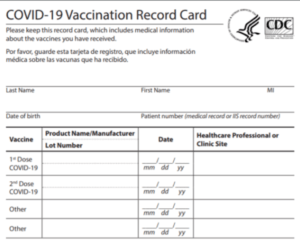
Stories about falsified vaccination cards are now peppering my newsfeed, including government seizure of fake vaccine cards at the border, and highlights of people who got caught attempting to travel to Hawaii with fake vaccination cards in attempt to and avoid mandatory quarantine. The woman whose card said she received a “Maderna” vaccine and the father who presented with vaccine cards for his 5- and 6-year-old children – far too young to be eligible for the vaccine – are the most memorable.

FELTG readers are likely aware of President Biden’s Executive Order 14043 last week requiring all Federal employees to be vaccinated against COVID-19. (FELTG instructor Katie Atkinson and I recently discussed the new vaccine requirement on an episode of the FedUpward podcast.)

This new EO reflects the administration’s increased push to get all eligible Americans vaccinated, and on Monday the White House set the vaccination deadline as November 22. The EO follows a July requirement that employees attest to their vaccination status, otherwise be mandated to weekly testing, limits on official travel, wearing face masks, and physically distancing, plus following other protocols the CDC recommends for unvaccinated people in the workplace.

New! On September 16, 2021, updated guidance was issued:

Q: Must agencies require documentation from employees to prove vaccination status?

A: Yes, agencies must require documentation from employees to prove vaccination, even if an employee has previously attested to their vaccination status. Employees may provide a copy of the record of immunization from a health care provider or pharmacy, a copy of the COVID-19 Vaccination Record Card, a copy of medical records documenting the vaccination, a copy of immunization records from a public health or state immunization information system, or a copy of any other official documentation containing required data points. The data that must be on any official documentation are the type of vaccine administered, date(s) of administration, and the name of the health care professional(s) or clinic site(s) administering the vaccine(s). Employees must certify under penalty of perjury that the documentation they are submitting is true and correct.

Employees may provide a digital copy of such records, including, for example, a digital photograph, scanned image, or PDF of such a record that clearly and legibly displays the information outlined above. In requesting this information, agencies should comply with any applicable Federal laws, including requirements under the Privacy Act and Rehabilitation Act of 1973.

Q: Are there penalties for providing false information on the vaccination attestation form?

A: Federal employees who make a false statement on the Certification of Vaccination form could be subject to an adverse personnel action, up to and including removal from their position. It is also a Federal crime (18 U.S.C. § 1001) for anyone to provide false information on the form. Falsification could also affect continuing eligibility for access to classified information or for employment in a national security position under applicable adjudicative guidelines.

The Task Force will be releasing additional guidance on vaccination requirements later this week, and we’ll be sure to keep you informed. In addition, we’ll be dealing with this topic and more in the October 26 webinar Post-Pandemic Accountability: Handling Employee Performance and Misconduct in a COVID-19 World. That webinar is the final session of the three-part series Navigating the Return to the Federal Workplace, which begins October 12 and includes discussion on EEO issues related to vaccines, reasonable accommodation, and more. Hopkins@FELTG.com

By Ann Boehm, September 14, 2021

In a recent training session, an attendee raised this scenario: “A political appointee is close friends with an agency union official, and we are pretty much being told to do whatever the union wants. Do you have any advice for how a labor relations specialist can effectively deal with this situation?”

Yes, in fact, I do. And I’m going to start with a little history lesson.

The Federal Service Labor-Management Relations Statute (the Statute), 5 U.S.C. Chapter 71, was passed as part of the Civil Service Reform Act of 1978. In 1978, Democrats held significant majorities in both the House of Representatives and the Senate. President Carter was a Democrat. President Joe Biden was a Democratic Senator at that time.

Historically, Democrats tend to be more pro-union than Republicans. If we presume that the leaders who created the Statute leaned pro-union, then we have to consider why they bothered to create a Statute that carefully outlines rights and obligations for both agencies and unions.

In section 7116, the Statute establishes what constitutes an unfair labor practice by an agency, and also what constitutes an unfair labor practice by a union. So, the Democratic leadership in 1978 acknowledged that unions are not always right. They may even commit unfair labor practices.

Section 7114(a)(2)(A) explains that the union has a right to be present at any “formal discussion between one or more representatives of the agency and one or more employees in the unit or their representatives concerning any grievance or any personnel policy or practices or other general condition of employment.” Note that it does not say the union has a right to be present any time management meets with employees. Congress created limits.

The Statute established management rights, expressly providing in section 7106(a) management rights that are outside the duty to bargain with unions. There is also a whole section (section 7120) that establishes “Standards of conduct for labor organizations.”

I won’t bore you by going through all the provisions of the Statute, but I promise you that it is full of limitations on what Federal employee labor unions can and cannot do. The Statute, created by Democrats, does not say that unions can do whatever they want during Democratic administrations.

I acknowledge that this Administration is setting a pro-union tone. I read an article that called President Biden the most pro-union president since Lyndon Johnson. So, there’s that. I also acknowledge that the last Administration was pretty darn anti-union.

There is a shift going on here. But it does not mean that agencies must do whatever the union wants.

My advice, then, to those of you who may be dealing with a scenario like the class attendee is this:

Educate the leadership. Explain that the Statute guides all things Federal sector labor relations. Congress did find in 1978 that unions are in the public interest (section 7101(a)). But in so finding, Congress also stated this (section 7101(b)):

“It is the purpose of this chapter to prescribe certain rights and obligations of the employees of the Federal Government and to establish procedures which are designed to meet the special requirements and needs of the Government. The provisions of this chapter should be interpreted in a manner consistent with the requirement of an effective and efficient Government.” (emphasis added)

Keep that language handy. Sometimes unions have good ideas, and they can help employees and agencies work efficiently on behalf of the American people. When they do not contribute to an effective and efficient Government, they are not doing what the 1978 Democratic leadership intended. Make the leaders aware. And remember, you have a lovely guidebook that does not care about the political party in charge – the Statute. That’s good news. Boehm@FELTG.com

By Shana Palmieri, LCSW, September 14, 2021

The goal of Federal workplace investigations is to collect information in an objective manner through a series of techniques that provides information to uncover the ‘truth,’ allowing the agency to make appropriate decisions and actions. Unfortunately, the human mind and memory is tricky business. Since the 1960s, social scientists have produced numerous studies that demonstrate eye-witness testimony and memory are unreliable.

To make matters more complicated, memory is formed and stored differently in individuals under extreme stress from trauma. To conduct proper investigations, it is pertinent to understand the underpinnings of memory retrieval and have a toolkit of evidence-based techniques that will allow the investigator to obtain accurate, reliable information. [Editor’s note: Shana will be a presenter during FELTG’s upcoming Workplace Investigations Week (December 6-10) and will share guidance on interviewing witnesses who have experienced trauma, de-escalating emotionally charged interviews, and more during Conducting the Investigation, Part I on December 8.]

Memory includes three primary processes:

Encoding. Individuals receive information based on what they see (visual), hear (acoustic), and understand (semantic). The brain then encodes the information deemed important and lets go of what it considers less important information.

Storage. The brain takes these selected details and consolidates them into a memory in the brain based on the details selected from the encoding process combined with our current knowledge to reconstruct what we ‘think’ happened in the past.

Retrieval. Retrieval involves the recall of old memories to form a narrative of past events and our recollection of what we ‘think’ happened. People are only able to retrieve a portion of their actual memories, and these memories when retrieved are combined with additional memories, events, and beliefs that have occurred since the initial memory was consolidated.  What this means is that when we retrieve a memory, we are not retrieving the initial memory that was encoded and consolidated, instead we are retrieving a memory that has been reconstructed and changed over time.

Memory systems in humans are not like replaying a video or audio recording that gives us a play-by-play of the exact details that occurred. Rather, the human memory selects what it believes the key factors are to encode, then uses current beliefs to consolidate a narrative that changes over time. This creates problems for obtaining an objective account of what occurred in the past built on a memory-based interview.

Add in other complicating factors, such as trauma, to impact the functioning on the memory systems, and the interview process becomes more challenging. Due to the activation of the stress response system, memories are often fragmented. Additionally, the type of memories the brain decides to encode differ than that of individuals not under extreme stress. And, finally, individuals under extreme stress as a result of trauma often do not store memories in a chronological fashion, making the retrieval of the incident difficult for the purposes of an investigation.

Therefore, specific investigative tools and interview techniques need to be applied when working with individuals that are impacted from extreme stress or trauma.

These techniques allow investigators to ask questions in a way that aligns with the way individuals store, retrieve and process information, allowing for a more objective investigation. Info@FELTG.com

By Barbara Haga, September 14, 2021

This month, we tackle a few other aspects of the work and conduct expectations that I began in last month’s article, in which I tackled work schedules, attendance and other related matters.

INTERNAL WORK REQUIREMENTS.  The following standards relate to how work gets done within our organization.

Standards for Work Assignments:

Due Dates: Certain assignments have specific due dates. Sometimes these are recurring items which have due dates such as monthly reports. In addition, various actions and projects will have due dates which may be either immediate or months in advance. Employees are expected to comply with due dates unless an extension has been given for good cause. If there are problems meeting a deadline, you are expected to notify your supervisor sufficiently in advance for alternative arrangements to be implemented to meet the deadline.

Priorities. Depending on the grade of your position, you may be responsible for setting work priorities or that information may come from your supervisor. You are expected to ensure that work is appropriately prioritized within guidelines and to raise issues regarding any competing priorities with your supervisor in advance to ensure timely completion.

Compliance with Directives. In some cases, work assignments are made with specific instructions or directives that explain how the work will be performed. Employees are expected to follow such protocols, directives, or procedures where they have been provided. This is not intended to limit opportunities for improving procedures or adapting to new conditions, but instead to ensure that supervisors are made aware of proposed adjustments in advance.

Files and Records: Any files or records that you develop in the course of your work are the property of the agency.

Sharing Information within the Unit: Staff meetings provide an opportunity for sharing information regarding our organization and our work and are a key ingredient to ensure that everyone on the team is aware of developments and changes that affect us.

Regular attendance at staff meetings is expected. In the event that there is a conflict with another meeting or work commitment, you are expected to notify your supervisor to discuss the conflict prior to the day of the staff meeting.

During staff meetings, you are expected to fully participate and to contribute to the information-sharing within the group. You should prepare as necessary to be ready to engage fully in discussions and to contribute well-thought-out suggestions.

(If status reports are required, include information on due dates/content here). Status reports ensure that your supervisor has up to date information on key parts of each employee’s work that then enables the supervisor to respond when issues arise from senior officials and customers.

Communications:

E-mail: If you receive an e-mail requesting information or assistance, you are expected to respond within one business day of receipt. If you are not able to satisfy the request within one day, you will acknowledge the request and include an estimate of when you will be able to satisfy the request.

If you are going to be out of the office, you will utilize the auto-reply on your e-mail to alert others to the fact that you will be out for a specific period of time. Your auto-reply message is also to provide an alternate point of contact(s) who is providing coverage in your absence.

Telephone:  If you receive a phone call requesting information or assistance, you are expected to respond within one business day of receipt.  If you are not able to satisfy the request within one day, you will return the call and provide the caller an estimate of when you will be able to satisfy the request.

If you are going to be out of the office, you will change your greeting to alert others to the fact that you will be out for a specific period of time.  Your message is to include an alternate point of contact(s) who is providing coverage in your absence.

Personal Telephone Calls and E-mails. Work time is to be spent performing work activities. Reasonable time for short check-in calls with family or making calls or sending e-mails for personal business that cannot be accomplished outside of work hours are permitted.

Required Training.  Employees whose jobs have specific training requirements are expected to complete such training by any established deadline.  Training may range from annual IT Security or Ethics Training to continuing education requirements for certain position. Once notified of a due date for training it comes your responsibility to ensure that you comply.  Multiple reminders should not be expected. Failure to complete required training on time is grounds for disciplinary action.

Licenses and Certifications. Some jobs include requirements for licenses and certifications.  It is incumbent on you to ensure that any continuing education is completed in a timely manner and that any administrative requirements to maintain such a license, certification, or membership are met.  Failure to meet these conditions of employment may be grounds for removal.

ON AND OFF-DUTY BEHAVIOR. Federal employees are accountable for behavior both on and off-duty. Off-duty behavior may be a basis for employment action if there is a connection between the behavior and the position.

Off-duty behavior such as egregious sexual misconduct may be grounds for dismissal.  Other types of specific off-duty misconduct could impart an employee in a particular type of position or job; for example, an employee whose job requires a license to drive who loses that license because of a DUI conviction may be removed because he/she doesn’t meet a condition of holding the job. Similarly, an attorney who loses membership in the bar would no longer qualify for that position.

Certain jobs may have more stringent requirements than others.  Police and investigator positions, for example, are generally held to higher standards since it is their responsibility to enforce laws, testify in legal proceedings, etc.  Jobs that are designated as highly sensitive or those who which require security clearances may be held to stricter rules regarding off-duty issues such as indebtedness. Supervisory jobs are also held to a higher standard.

By Michael Rhoads, September 14, 2021

I’ve always regarded Labor Relations like the old Rubik’s Cube. There are a seemingly endless number of twists and turns before arriving at the final solution. I admire the tenacity of those who have made a career out of LR.  It’s not for the faint of heart, especially when engaged in “robust debate.” And to make it even more interesting for those practicing LR in Federal agencies, the message from the top-down changes with each new Presidential administration.

Permissive Bargaining

Since President Biden revoked The Presidential Memorandum of October 11, 2019 (Executive Orders 13836, 13837, and 13839) in Executive Order 14003, management has been asked to operate under a new set of bargaining rules. The Biden administration even set the tone by stating: “It is also the policy of the United States to encourage union organizing and collective bargaining.”

Of particular note in EO 14003 is section 4. Ensuring the Right to Engage in Collective Bargaining. “The head of each agency subject to the provisions of chapter 71 of title 5, United States Code, shall elect to negotiate over the subjects set forth in 5 U.S.C. 7106(b)(1) and shall instruct subordinate officials to do the same.”  This is a 180-degree turn from the previous administration, who said the agency “may not negotiate” over the subjects of 7106(b)(1).

OPM also issued a memo on March 5, 2021 in support of the topics covered in 7106(b)(1). “In order to implement the policies of the Executive Order, agencies shall agree to bargain over the substance of §7106(b)(1) subjects, whether at the union’s request (e.g., midterm bargaining request) or as the result of a proposed agency action (e.g., union responding to an agency notice of a pending change subject to collective bargaining).

Requests for Information

The new permissive bargaining sets the stage for new negotiations between management and the unions representing bargaining unit employees.  During these negotiations, the union will most certainly request information from management. Requests for information can sometimes feel like the children’s book If You Give a Mouse a Cookie: one request leads to another, and another, and another, ad infinitum.  But no matter how many requests a union submits to management, they must demonstrate a particularized need for the information.

The types of information a union can request from management are covered in 5 USC 7114(b)(4):

(4) in the case of an agency, to furnish to the exclusive representative involved, or its authorized representative, upon request and, to the extent not prohibited by law, data—

(A) which is normally maintained by the agency in the regular course of business;

(B) which is reasonably available and necessary for full and proper discussion, understanding, and negotiation of subjects within the scope of collective bargaining; and

(C) which does not constitute guidance, advice, counsel, or training provided for management officials or supervisors, relating to collective bargaining

If you’re a labor relations specialist looking for best practices on how to negotiate in this new climate, look no further.  Join my colleague, Ann Boehm on Friday, October 1, 2021 for 2 sessions Permissive Bargaining from 11:15-12:30 PM EDT, and Requests for Information from 1:30-2:45 PM EDT.  And be sure to check out our other topics in our upcoming end-of-FY virtual event Federal Workplace 2021: Accountability, Challenges and Trends, which runs from September 27 – October 1.


As this fiscal year comes to a close, I wish everyone a productive September. Be safe, and remember, we’re all in this together. Rhoads@feltg.com


By Dan Gephart, September 14, 2021

Ever hear about the Federal employee who walked out of Whole Foods without paying for the two tacos in his hands? When stopped by security, he claimed he “thought the tacos were comped for Federal employees.”

Or how about the Fed who paid for his family’s entire Disney vacation with his government credit card? It was an accident, he said. He meant to use his own card. Yes, sure, it was an accident when he paid for the flight. And again, when he paid for the hotel. And again, when he paid for the rental car.

But what if the taco-buying Fed really did think he was comped? I don’t know, maybe he missed his day of ethics training. Or what if the Disney vacationer’s personal credit card looked almost identical to his government card?

Sometimes an employee’s excuse for misconduct may sound as illogical as the concept to the Broadway show Cats. Before you laugh off the premise, though, give it some consideration. After all, the MSPB once reversed an employee’s removal for failing a drug test when his excuse was that his soon-to-be-ex-wife laced his cigar with marijuana. The ol’ “my wife put weed in my cigar” excuse? Come on! That sounds like our drug-tested Fed was blowing smoke. But guess what? The evidence backed it up. After lacing the cigar, the wife called the employee’s supervisor and suggested her husband be drug-tested.

That evidence, however, was clearly missing for the IT specialist in Hansen v. DHS, No. 2017-2584 (Fed. Cir. Dec. 28, 2018). A random drug test revealed marijuana in his system and the agency proposed his removal for “positive test for illegal drug use— marijuana.”

The appellant claimed he unknowingly consumed drug-laced brownies at a party. Who hosted the party and secretly served pot brownies to unsuspecting guests? Well, the appellant didn’t actually “know” the host. In fact, he claimed, he didn’t even know the brownies were made with marijuana until days later. He said he never felt the effects of the marijuana and attributed what he did feel (mostly nauseous) to eating bratwurst.

The MSPB found that he failed to meet his burden of “showing such inadvertent ingestion” and affirmed his removal.

For more on Hansen and other similar cases, join FELTG President Deborah Hopkins, starting at 9:30 am ET on Thursday, September 30 for High Times and Misdemeanors: Weed and the Federal Workplace. If you’re looking for guidance on handling off-duty misbehavior in general, join FELTG Instructor Bob Woods for Got Nexus? Accountability for Off-duty Conduct on Tuesday, September 28, starting at 11:15 am ET.  Both sessions are part of our Federal Workplace 2021: Accountability, Challenges and Trends event, which runs event runs September 27-October 1. Click here to find out more about this exciting annual event. Gephart@FELTG.com

By Deborah Hopkins, September 14, 2021

Here’s the scenario: A complainant files multiple EEO complaints including complaints against an attorney in the agency’s Office of General Counsel and the agency’s EEO Director. The complainant requests the attorney and the EEO Director to recuse themselves from the case. The GC and EEO Director happen to be the employees who handle most EEO matters and litigation for the agency in this particular region.

Because of her experience, the attorney would like to be involved in defending the agency against the complaints rather than create a firewall and pass this case off to a less-experienced attorney. And the EEO Director doesn’t want to recuse because he believes there is no merit to the EEO complaint.

What should the agency do?

Ideally, the agency should have a conflict policy in place and an agreement with another region or even another agency to step in for the investigation and defense of complaints in situations like this.  The EEOC issued a report last year with guidance on these conflict policies.

If the agency doesn’t have a conflict policy in place now, the below case discusses the conflict issue and should encourage the agency to address this as soon as possible: Katharine B. v. USPS, EEOC App. No. 0120170444 (Dec. 7, 2018).

“In Monroig, the Commission held that permitting the Deputy General Counsel, one of the responding management officials, to attend the hearing and simultaneously act as agency representative would create an inherent conflict of interest and tarnish other witnesses’ testimony.

EEO Management Directive 110 (EEO MD-110) (Aug. 5, 2015) requires that there be distance between the fact-finding and defensive functions of the agency in order to enhance the credibility of the EEO office and the integrity of the EEO complaints process. EEO MD-110, Chapter 1, at § IV (Aug. 5, 2015). The Commission ruled that even if the Deputy General Counsel had testified before all other witnesses at the hearing, her presence would discourage other employees from testifying freely at the hearing.

The Commission noted that the Agency was well represented at the hearing despite the Deputy General Counsel’s absence.

Accordingly, we find that a conflict of interest existed in the Agency’s representation at [*13] the hearing and that Complainant is entitled to a new hearing, in which S1 may not be involved as an Agency representative. See Rabinowitz v. U.S. Postal Serv., EEOC Request No. 05930348 (Sept. 23, 1993) (officials involved in discrimination may not be involved in processing the complaint).” [bold added]

Bottom line: Take conflict allegations seriously. Find a way to recuse counsel or EEO officials who may have conflicts of interest. Better yet, get ahead of these situations now by putting together a conflict policy, as recommended by the EEOC. It may not be something that arises often but being prepared for a conflict will benefit the agency in the long run. Hopkins@FELTG.com

By William Wiley, September 7, 2021

Below is an email we received from a FELTG student, lightly edited for space and context, followed by our FELTG answer.

Dear FELTG,

I attended your MSPB Law Week in person last year just before everything was shut down due to COVID. I recall your discussion about performance management, and you made a statement that I swear I wrote down but cannot find in my notes. I was wondering if you might be able to reiterate. You said something along the lines of “Performance vs. conduct is not a matter of can’t do and won’t do.” This can’t vs. won’t is something I was taught as a young ER practitioner some years ago. However, your explanation was MUCH better!

Thanks in advance.

And the response:

Ah, the old “can’t do vs. won’t do.” Has a nice ring to it. The reason that FELTG teaches that this is an incorrect concept is based in law and, unfortunately, the law doesn’t always have a nice catchy rhythm.

If we read the statute that lays out the procedures for taking a performance-based removal (codified at 5 USC 4303), we don’t see anything that speaks to volition. Therefore, the willfulness of an employee’s unacceptable performance is not a matter of law with which we need to be concerned when initiating a performance removal. We don’t have to care whether the employee says, “Boss, I refuse to work that hard” or “Boss, I can’t work that hard.” If the employee is not performing at a level that the supervisor sets as the minimum level of performance, we can initiate a 432-performance action.

Being able to initiate a 432-performance action without concern for can’t v. won’t is important for several reasons:

  • It’s one less case element we have to prove on appeal. It gives the employee one less thing to argue with us about. Reducing arguments is a very desirable outcome.
  • 432-performance actions are a fast, efficient procedure for dealing with a documented non-producing employee. We can initiate a 432 action today by giving the employee a notice that specifies the performance elements being failed, and then propose the employee’s removal 31 days from now if performance does not improve to the minimal level. In contrast, a 752-misconduct action (a reference to 5 USC Chapter 75 adverse action removal procedures) many times involves an initial Reprimand (which might be grieved), followed by a proposed-then-decided Suspension (which also might be grieved), and THEN by an eventual proposed Removal. Those steps invariably take more than 31 days.
  • Separately, performance-based removals need be supported by only substantial evidence, whereas misconduct-based removals must be proven by the higher burden of a preponderance of the evidence. And MSPB cannot mitigate a performance-based removal to something else. No Douglas Factors to worry about. 432-removals are the preferred procedure to deal with problem employees who can’t or don’t do what they are told to do performance-wise.

In addition to all of this, we have to acknowledge that there are exceptions to the concept that can’t-do problems are necessarily addressed via a 432-performance-based action. We routinely use 752-adverse-action procedures to remove employees who can’t do things, e.g.:

  • The employee who can’t come to work because of matters beyond the employee’s control where leave has been approved (Excessive Absence)
  • The employee who has a medical limitation and, thereby, can’t perform an essential job function (Medical Inability to Perform)

I hope you either read one of our earlier FELTG articles and/or attended our webinars that explained that the Federal Circuit recently changed what management is required to do when confronted with a non-performing employee. Previously, we had to prove that the employee was put on notice of on-going unacceptable performance (usually by the supervisor initiating a Demonstration Period, i.e., a DP), and then prove that the employee did not perform acceptably during the DP. Now, we also must prove that the employee was performing unacceptably BEFORE the DP was initiated.

Bottom Line: Assessing whether a problem with an employee is “can’t do or won’t do” is unnecessary and possibly misleading. It’s better just to focus on the outcome when dealing with a poor performer. When it comes to the concept of volition – can’t do vs. won’t do – Master Yoda said it most succinctly, “You must unlearn what you have learned. … Try not. Do, or do not. There is no try.” Hey, if we can’t rely on the wisdom of a little, old, green alien, who can we trust?

Best of luck out there. Wiley@FELTG.com


By Deborah Hopkins, August 13, 2021

Over the last four years, the VA has enjoyed a lower burden of proof in taking disciplinary actions against employees covered by the VA Accountability and Whistleblower Protection Act, 38 USC 714. Indeed, Congress passed this law in 2017 to make it easier to fire bad employees at the VA.

Between then and today, we have learned that the law is not retroactive for actions that occurred prior to its enactment (Sayers v. VA, 954 F.3d 1370 (Mar. 31, 2020); Brenner v. VA, No. 2019-2032 (Mar. 9, 2021)) and that, while MSPB has no penalty mitigation authority in actions taken under this law, agencies must show by substantial evidence that their selected penalty is reasonable. Mogil v. VA, No. 2018-1673 (Fed. Cir. May 1, 2019). Ok, fine. We can live with that.

Now, get ready.

On August 12, the Federal Circuit hit us with a big one. In this case, a Supervisory Consumer Affairs Specialist named Ariel Rodriguez yelled and used profanity at a patient in a VA facility. The confrontation escalated and the police were called. The police had to escort Rodriguez to his office because he was so agitated. After that, Rodriguez returned to the reception area, where he again confronted the patient. During the investigation that followed, Rodriguez was dishonest in his account of the events that occurred. He also attempted to influence one of his employees to alter her testimony to the investigator.

Rodriguez was removed on three charges: (1) disruptive behavior toward a veteran patient; (2) conduct unbecoming a federal supervisor, and (3) lack of candor. The facts justified an easy removal for the VA – or so we all thought. Plenty of witnesses, police activity, a patient’s wellbeing in danger, clear nexus – no question there was substantial evidence of misconduct and substantial evidence to support removal.

But wait.

The Federal Circuit saw things differently. There are two huge new takeaways that every management official at the VA must be aware of, courtesy of this case, Rodriguez v. VA, No. 2019-2025 (Fed. Cir. Aug. 12, 2021).

  1. The standard of proof for a VA to take a disciplinary action is a PREPONDERANCE of the evidence; the substantial standard in the statute only refers to MSPB’s review of the action.
  2. The VA must complete a Douglas factors analysis for its disciplinary actions, even though the MSPB lacks authority to mitigate the agency’s penalty.

Let’s look at each in turn.

  1. Burden of Proof

For the past four years, just about everyone in this business has been under the impression that the language in 38 USC 714(d)(2)-(3) “if the decision is supported by substantial evidence” meant that the agency action also required the substantial evidence standard. It’s even in the VA’s Discipline policy.

But the Federal Circuit said otherwise:

The references to “substantial evidence” in section 714 are all explicitly directed to the standard of review to be applied by administrative judges and the Board. Those references do not address the standard of proof to be applied by the DVA in making disciplinary determinations, nor does the remaining text of section 714 explicitly address the standard of proof in proceedings before the DVA…[T]he language of section 714 implies that the proper standard is the preponderance of the evidence. Section 714 provides that an employee may be removed, demoted, or suspended “if the Secretary determines the performance or misconduct of the covered individual warrants” such action. In the case of a disciplinary action based on misconduct, the requirement that the Secretary “determine” that the misconduct in question warrants disciplinary action implies that the Secretary must find that it is likely, i.e., more likely than not, that the employee has engaged in the misconduct that justifies the proposed discipline. [bold added]

The court’s explanation included discussion that if substantial evidence was the standard used, a Deciding Official would be required to find against the employee with regard to the charged misconduct even if the Deciding Official did not personally agree with that conclusion, because when substantial evidence is applied, a reasonable person might disagree and yet the standard is still met. The court said in no uncertain terms that the VA Accountability and Whistleblower Protection Act does not contain “any language stating explicitly, or even implicitly, that the burden of proof in disciplinary actions should be substantial evidence.”

Because the agency applied the substantial evidence standard in this case, what we now know is an incorrect standard, it was remanded back to the MSPB.

  1. Douglas Factors

Because the VA Accountability and Whistleblower Protection Act explicitly states that the MSPB does not have the authority to mitigate the agency’s penalty (38 USC 714(d)(2)(B)), in the first year or two after the law’s enactment the VA was (and the rest of us were) under the impression that Douglas factors were not required. In other words, if a penalty could not be mitigated, then there was no need to justify the penalty – and penalty defense is the primary reason why agencies use the Douglas factors.

Starting in 2019, the Federal Circuit determined that there must be substantial evidence the agency’s penalty is reasonable, otherwise the MSPB could remand a case back to an agency to determine a more appropriate penalty. Mogil, above.

The court in Rodriguez takes things further and says, “this court has made clear that the absence of mitigation authority does not deprive the Board of the authority to review penalties for substantial evidence” and that mitigation authority is completely divorced from “the power to review and strike down the DVA’s imposition of penalties that are arbitrary, capricious, an abuse of discretion, or not in accordance with law.” To that end:

For a reviewing tribunal to find a decision not arbitrary, capricious, an abuse of discretion, or otherwise not in accordance with law, that decision must have been based “on a consideration of the relevant factors and whether there has been a clear error of judgment…” [citation omitted] Accordingly, because the Board must review the DVA’s penalty selection in a section 714 case, that review must ensure that the DVA considered the relevant factors bearing on the penalty determination.

The court emphasized this point by declaring the Deciding Official must “weigh the relevant factors bearing on the appropriateness of the penalty, including the relevant Douglas factors” in cases of misconduct. So, there it is.

There is a whole lot more to discuss from this decision, but we’ll tackle those issues another time. As for now, we are anticipating multiple years’ worth of cases will be remanded to determine whether the VA had a preponderance of the evidence, and not merely substantial evidence, in taking appealable disciplinary actions. The good news for the VA is, preponderance is not too difficult to show, and I would bet they can meet this burden in nearly every case. The bad news is there’s a whole lot more work ahead. Please let us know how we can help – and attend UnCivil Servant September 8-9 or MSPB Law Week September 13-17 for all the details on what happens now. Hopkins@FELTG.com