
By Dan Gephart, July 21, 2021

Residents from our cozy colonial-era town of Haddonfield, NJ, returned in droves to this year’s July 4 parade. (Last year’s parade was canceled due to COVID.) The streets were packed with enthusiastic and smiling (no masks!) residents, who watched as the Shriners drove circles in their tiny cars, a group of Mummers strutted, and the town’s oldest resident (102 years young) waved from a convertible.

The Stars and Stripes was ubiquitous. Parade-watchers held high the tiny flags handed out by the local Boy Scout troop, while larger American flags fluttered from every light pole in town.

As we walked home after the parade, I noticed our town was full of flags, and not all of them Old Glory. Flag makers reported an increase in sales during the pandemic, and we were seeing the results of it. I’m guessing it had something to do with people spending more time stuck at home.

The Rainbow Pride flag was the one we saw most. We saw a couple of Thin Blue Line flags. A Black Lives Matter flag hung from a porch. Another bright flag summoned us to celebrate summer, while another shouted “Freedom!” The one that made us laugh was giant black flag with white lower-cased letters spelling “freak.”

And on the corner a couple of blocks off the main street was a house flying the Gadsden flag. That’s the one depicting a rattlesnake with the words “Don’t Tread on Me” over a yellow background. If you’re in the Federal EEO community, you may know the Gadsden flag from the EEOC’s decision in Complainant v. US Postal Service, EEOC Appeal No. 0120141334 (June 20, 2014). Or, you probably know it from the clarification the EEOC sent out after its ruling:

The EEOC noted that while the Gadsden Flag originated in a non-racial context, it has since been “interpreted to convey racially-tinged messages in some contexts.” The EEOC cited its use by persons associated with white-supremacist groups who used the flag to drape the bodies of two police officers they had just murdered, and its display at a Connecticut fire house that was met with protests by African-American firefighters, ultimately resulting in the flag’s removal. The EEOC underscored the fact that it did not find that the Gadsden Flag in fact is a racist symbol. Instead, the EEOC found only that the complaint met the legal standard to state a claim under Title VII, and therefore should have been investigated by the USPS rather than dismissed.

With the rise of white supremacist and anti-Semitic groups, flags have taken on meanings that may not be that obvious. The Gadsden flag isn’t the only one that’s been appropriated by hate groups.

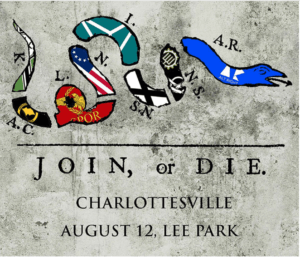
To the left is a flag based on a Benjamin Franklin cartoon published in 1754, urging the eight colonies (all New England is represented as one) to unite.

A few years ago, the Philadelphia 76ers embraced the Franklin cartoon for their NBA playoff logo, a flag of which can also be seen flying from a house on my block these days. [Sidenote to that neighbor: Are you lazy or what? That Game 7 loss to the Atlanta Hawks was nearly a month ago. Why must you keep reminding me of that disappointment?]

Meanwhile, white supremacist groups have seized on the cut snake logo, as seen by the poster that promoted the deadly “Unite the Right” rally in Charlottesville. Instead of uniting colonies, the poster proposes uniting hate groups.
During the video replays of the Insurrection at the Capitol, I saw numerous flags and symbols that I did not recognize, but later read were used routinely by white supremacist groups. Undoubtedly, those flags and symbols would create a hostile work environment if displayed in an office.

You don’t have to be a vexillologist (flag expert) to ensure a discrimination-free environment, but you do need to know the elements of a hostile workplace, which are:

1)    The conduct is unwelcome. That conduct could be words, jokes, touching or objects and pictures displayed.

2)    The conduct is based on a protected EEO category: race, color, national origin, religion, gender, disability, age, genetic information, or reprisal.

3)    The conduct is severe and/or pervasive.

If a flag heralded by a white supremacist group is displayed in your workplace, I’m pretty sure it’s going to check off all the boxes. (For a thoughtful legal analysis of a more challenging potentially hostile environment case, read FELTG President Deborah Hopkins’ Does Saying ‘All Lives Matter’ Create a Hostile Work Environment?)

The next step is up to you: It’s your responsibility to protect employees from harassing conduct.  Take action. Immediately. An example of what not to do can be found in Complainant v. United States Postal Service (Southeast Area), EEOC Appeal No. 0120132144 (Nov. 1, 2013). In that case, the EEOC reversed the agency’s final order and remanded the matter to the agency because it found that complainant had established that he was subjected to unlawful harassment based on race and the agency was liable for harassment.

In this case, the offending objects were t-shirts emblazoned with the Confederate flag worn by two white clerks. Initially, the AJ, while finding discrimination, did not find agency liability. The Commission saw it differently.

The shirts were worn about a dozen times over several months starting in August 2010. The agency took no action against the shirt-wearers until prompted to do so by a union grievance in May 2011, when one of the clerks was sent home to change. In fact, at one point in April 2011, the clerk was told there was “nothing wrong” with his shirt.

The agency’s supposed corrective step was a stand-up talk about work attire. During that talk, however, employees were never instructed not to wear or displays images of the Confederate flag.

When symbols of hate take hold in the federal workplace, there’s no room for mixed messages. Gephart@FELTG.com

By Meghan Droste, July 21, 2021

Repetition can be a good thing.  That’s why practice makes perfect, and you measure twice before cutting once.  We repeat things to make sure we get them right. But repetition isn’t always a good thing. Sometimes, it means that we’re not learning from our mistakes. And in a recent decision, it seems like the Commission may be tired of repeating itself on the issue of agencies improperly dismissing complaints from contractors.

In Alfredo S. v. Department of the Army, EEOC App. No. 2021001400 (June 7, 2021), the complainant was a Lockheed Martin employee working on a military base. He filed an EEO complaint alleging a hostile work environment and a discriminatory termination of his employment. The agency dismissed the complaint without an investigation in a decision that did not describe “any relevant facts, case law, or analysis …”  The agency merely stated that the complaint failed to state a claim because the complainant was not an employee or applicant for employment.

After reciting the standard description of joint employment and the various factors it weighs in determining whether an agency is a joint employer, while also noting that the agency “has not even touched on any supportive evidence in its decision,” the Commission took issue with having to repeat itself in these types of improper dismissals. It notes that “[t]his is not the first time a dismissal for lack of standing, by this Agency, has been found to be deficient.” (emphasis in original). The Commission addressed the agency’s analysis of the joint employment factors, presented for the first time in its response to the complainant’s appeal. The Commission rejects the analysis, finding it insufficient and not supported by the evidence presented in the appeal. In part, the agency’s argument failed because it did not conduct an investigation and, therefore, did not have relevant documents to support its arguments, including a copy of the contract with Lockheed Martin and documents relating to an earlier complaint raised by the complainant.

Although, in this decision, the Commission is taking issue with this specific agency, it could write the same thing in reference to many other agencies. Unfortunately, this remains a recurring mistake across the federal government, with agencies seemingly automatically dismissing complaints from contractors without any analysis, or with an analysis that places too much emphasis on the language of a contract and fails to acknowledge or address the day-to-day reality of a complainant’s work situation. There are at least seven other decisions already this year involving the same issues with other agencies.

I strongly encourage you not to repeat this mistake as so many others have already. It is not a winning strategy. It only results in delaying the inevitable — a complete investigation of the complainant’s allegations along with evidence regarding joint employment. Droste@FELTG.com

[Editor’s note: For guidance on handling contractor complaints, join FELTG for Day 3 of EEOC Law Week on September 22 from 9 am – 4 pm. For more information or to register, click here.]

By Michael Rhoads, July 21, 2021

When I was a Rotary foreign exchange student in Argentina, the hardest thing this Yankee with two left feet did was learn the basic step of the tango – an intimate and graceful dance once mastered. The key to dancing the tango well is learning how to communicate to your partner the next step you want to take to avoid stepping on toes – or even worse, tripping over one another altogether.  Just like any novice, I had my fair share of trips and sore toes while learning.

The pandemic forced us to learn new moves and ways of working. Now that we’ve learned how to telework, employees and managers alike are now faced with a new question: How much telework is the right amount?

Return to Work?

This return to work will not be as cut and dry as simply returning to the office and resuming what was once considered “normal.” After successfully teleworking for over 16 months, many employees will want to retain some of the flexibility that telework provides.

Federal agencies are in the phased re-entry period, defined by the Biden Administration for the White House as July 6 – July 23.  FELTG recently hosted a webinar dedicated to getting your agency’s return to work guidance ready, which was due July 19th.

It will be important for you to look at your agency’s guidance when considering an employee’s request for telework. In the meantime, OMB has offered some guidance and recommendations. When dealing with employees who are currently teleworking, OMB recommends flexibility. M-21-25 states the government is: “Open with maximum telework flexibilities to all current telework eligible employees, pursuant to direction from agency heads.”  When scheduling telework, consider whether in-person work is necessary to “satisfy business operations, team-building, and other needs.” During the transition back to the office, your agency may also authorize telework for those with dependent care obligations.

Some employees are ready to return to the camaraderie and in-person interaction with co-workers. To ease the transition, some agencies have offered voluntary return-to-work as offices allow for increased capacity.

The Way Forward

The working relationship between managers and employees is as intertwined as two tango dancers.  There may be times you trip over one another but remember: Communication is the key.  If that communication is clear, you can avoid stepping on each other’s toes when the telework requests start to come in from employees.

While your agency is still trying to master the new telework dance, FELTG has looked at all the complexities of telework, and how your agency can navigate the changes and requests as employees transition back to the office.

Join us July 26-30 for The Post-Pandemic Federal Workplace: Managing Accountability and EEO Challenges. Our event will cover a broad array of telework challenges:

  • Holding teleworkers and other remote workers accountable for performance and conduct
  • Special telework performance and conduct challenges
  • OPM’s telework flexibilities; telework as reasonable accommodation
  • Agency options when employees refuse to report to the physical workplace

I’ll see you at the next milonga, and remember, we’re all in this together.  Rhoads@feltg.com

By Meghan Droste, July 21, 2021

This month, we continue the discussion of retaliation. Last month, the tip was not to do it. While that might seem obvious, it happens regularly and the EEOC has cautioned that may be, in part, due to a lack of training for supervisors on how to manage interactions with employees. This month, we focus on the next question that naturally follows: What is it? In order to stop yourself from doing it, it’s important to know what retaliation actually is.

The easy answer is that a retaliatory action is anything done in response to protected activity that might have a chilling effect. That means, any action that might discourage the complainant from engaging in protected activity in the future. Sometimes, this can be obvious to identify.

For example, in a recent decision, the Commission found per se retaliation due to a supervisor speaking about the complainant’s EEO complaint in an angry voice, and another supervisor telling the complainant that he was offended by her allegations. See Tomeka T. v. Dep’t of the Treasury, EEOC App. No. 2020000390 (June 15, 2021).

So, the first part of this tip is to avoid discussing an EEO complaint with an employee unless there is a specific need to (for example, asking for more information to clarify a request for official time). If you make comments that specifically reference an employee’s complaint, there is a good chance that you are at risk for committing per se retaliation.

One thing that often trips agencies up in the processing of retaliation claims is looking for something “bigger” that has happened and dismissing a claim or finding no retaliation if the retaliatory act seems too small.  While of course not everything will rise to the level of a chilling effect, it is important to remember that the adverse action does not need to be an “ultimate employment action.” It does not have to be something as big as a removal, demotion, or a suspension.  The Commission’s recent decision in Ronnie R. v. Department of Defense, EEOC App. No. 2021001510 (June 14, 2021) is an example of how agencies can make this mistake.

In this case, the complainant alleged the agency retaliated against him when his supervisor denied his request for official time to speak with an EEO counselor and instructed him to go to the security office for an investigation of theft involving four bolts.  The agency dismissed the claim for failure to state a claim, finding that “there was not a disciplinary action or harm resulting” from the alleged retaliatory actions.

As the Commission noted in its decision reversing the Agency’s dismissal, “when an individual alleges retaliation in a complaint, they do not need to make a showing of adverse employment action.” The action need only have a chilling effect, or the potential of one, to state a claim of retaliation. That brings us to the second part of the tip: Be careful not to apply the incorrect standard when looking at whether something was retaliatory.  Droste@FELTG.com

By Barbara Haga, July 21, 2021

Over the past two columns, we reviewed what position descriptions should cover to give you maximum ability to determine qualifications, establish accountability, and to hire well. We also looked at crafting performance standards that effectively build on position requirements. There’s another aspect of establishing accountability that often ties in with the position description. That’s setting conduct requirements. This brings us back to the issue I started with when I began this series.

The idea expressed by a supervisor was that if something wasn’t in the performance plan, she wouldn’t be able to hold the employee accountable for it. If that “something” was how well a particular job function was performed – was it done correctly, in accordance with policy, on time, notifying appropriate team members or customers. etc. – she would have been correct. However, what she had in the standards was a requirement for an accountant to take continuing education courses toward a Financial Management Certification.

There seems to be a myth out there in the world of Federal HR that the performance plan is intended to cover everything that happens between 8 and 4:30 (or whatever your schedule is).  Nothing could be further from the truth.

The performance plan only captures how well the individual performs on those things covered in the critical elements as measured by the performance standards. All other things inevitably fall into the conduct world if things go wrong.  If the individual can’t meet medical standards, we would be looking at a conduct action. If the employee loses his membership in the bar, a performance action wouldn’t make any sense since the employee couldn’t perform the duties to begin with. If the employee misuses a travel card, the remedy will come from the conduct world.

Setting Conduct Standards 

The amazing thing about setting standards regarding conduct is that most of the time employees will comply.  My experience tells me that most people will stay within the lines – if they know where they are. The problem is that sometimes employees aren’t told where those lines are.

In many of my classes, I am teaching HR practitioners and managers from large, unionized agencies. In those agencies there are usually detailed handbooks and policies controlling employment matters, and union contract provisions add additional detail to what is contained in the agency documents.

Sometimes, I am at a small agency where they don’t have that sort of structure. This issue usually comes up quickly in a leave class. Even though I should be ready for it, I am often surprised. It starts like this:

Me:  When employees don’t call in for emergency leave within the allotted time frame, you could disapprove the leave. So, what is the allotted time frame here?

Students: (Blank stares.)

Me: (I think they didn’t understand what I meant.) How long does an employee have to call in for unscheduled annual leave or sick leave here?

Students: (Uncomfortable wiggling in chairs begins. But no response.)

Me: (Maybe an example would help them.)  In many Federal agencies, there is a set time frame like two hours from the start of the shift or one hour prior to the start of the shift for certain jobs.

Students: (Eyes cutting around the room.)

Finally, some brave soul admits they don’t have a policy on this, and they have never told their employees anything. Employees call in when they choose to.

If there are no standards for something like short-notice leave, then I would suspect that employees are not likely to be clear on many other things, such as when Government property can be removed, what happens when employees engage in harassment, and other similar issues.

Not only is that poor management, but it would also make it difficult getting past Douglas Factor number 9, regarding whether the employee knew or should have known that what she was doing was wrong.

Clarifying Expectations

Not everything is something that a supervisor need create.  For example, jobs that require licenses and certificates usually are covered by some type of agency guideline that explains what types of certificates are required for what grades. For example, DoD sets very specific requirements for firefighters and paramedics.

The same thing applies for IT professionals and contracting positions. The policies may also explain what happens when someone fails to get a certificate or license on the first try. Even with these policies in place, it would behoove the supervisor to make clear what happens if there is a failure. There may be a grace period and an opportunity to retest.  But, if an employee fails the retest, then typically the answer is that the individual can’t hold the position. For some jobs where the license is required to be qualified to enter and hold the position, such as a driver’s license or a medical clearance, there likely isn’t a grace period to try to retest. The employee can’t be allowed to perform the duties without the license.

I wrote a series of articles for the FELTG Newsletter in early 2019 on conditions of employment cases. One of the cases I wrote about was a firefighter who was also an EMT. He hid the fact that he had let his EMT certification lapse. The fact that he did not inform management would lead one to believe that he understood the consequences of practicing his level of medicine without a license. Saline v. Army, DE-0752-14-0567-I-1 (2015)(ID).

What other types of things might managers need to explain? What would happen if an employee needed to take government property out of the facility?  What kind of documentation is necessary? What would happen if the proper permissions weren’t obtained, and the individual is caught with that government property?  Is there an agency guideline on this topic that employees are expected to follow?

When could an employee use their personal vehicle for work purposes and how do they pay for gas? This question comes from an actual case. A GS-14 criminal investigator was removed based on credit card misuse because he used his travel card to buy the gas.  Apparently, the agency policy was to apply for mileage reimbursement. There was no allegation that he used the gas for anything other than official business. The proposing and deciding officials testified that they “assumed” that he knew the policy requirement. Needless to say, the Board mitigated the penalty. Johnson v. Treasury, 15 MSPR 731 (1983), aff’d without opinion (Fed. Cir. Jul. 22, 1983).

It’s clear that there are many things with conduct consequences that would warrant explanation by the supervisor, but none of them need to be in the performance plan for the employee to be held accountable.


By Deborah Hopkins, July 12, 2021

A few weeks ago, my colleague and FELTG Founding Father Bill Wiley drew my attention to a Federal Circuit decision that gave the Federal employment law world an important distinction in legal definitions. The case involved an IRS agent who disclosed confidential taxpayer information, including personally identifiable information (PII), to an unauthorized person for her own benefit. The unauthorized person was her attorney, and the information was disclosed as the attorney was preparing a response to a proposed suspension for “displaying discourteous and unprofessional conduct and for failing to follow managerial directives.”

The IRS removed the employee for “intentionally disclosing taxpayer information to an unauthorized person” and the MSPB AJ upheld her removal, agreeing with the agency that the misconduct was severe because “taxpayer privacy is ‘sacrosanct.’” In addition, the employee had received training on the importance of keeping taxpayer PII private, did not redact any PII before sending the information to her attorney, and did not receive permission from the agency to disclose the information.

She appealed her removal to the Federal Circuit. While acknowledging the disclosure of taxpayer PII was improper, she argued on appeal that removal was too harsh because “[t]he penalty imposed was that for willful disclosure, rather than negligent disclosure.”

Keep in mind, the charge was “intentionally disclosing taxpayer information to an unauthorized person.”

The Federal Circuit did not agree with her argument, but rather agreed with the MSPB that her “removal was properly predicated on her intention to disclose the information to her attorney and did not depend on whether she knew that the disclosure was wrong.” Therefore, it was not improper for the IRS “to consider such intentionality as aggravating.”

Now the fun part – the discussion on the use of the words willful and intentional. The court said that in the petition for review, the employee improperly referred to being charged with “willful disclosure” when her actions were actually charged as intentional. The court said these two words are sometimes used interchangeably but shouldn’t be. And then they told us why:

  • An intentional action is one that an employee commits on purpose, not negligently. It is not a requirement that the employee know the action is illegal, if the agency can show the employee’s intent was to commit the action at issue.
  • A willful action is different; it is an action an employee commits on purpose with knowledge that the act is prohibited. If there is no evidence the employee knew the action was prohibited, the misconduct is not willful, but may be intentional.

The IRS employee acted intentionally when she provided taxpayer information to her attorney. The agency did not charge her with willful disclosure and, therefore, was not required to prove that she specifically knew the act was prohibited by law. The employment law nerd in me just loves this kind of stuff. If you’d like to read the case yourself, it’s Vestal v. Treasury, Fed. Cir. No. 2020-1771 (Jun. 14, 2021). And for more fun discussions on disciplinary charges, join FELTG for the virtual training program Understanding Misconduct: Disciplinary Charges and Penalties, held on July 26 as part of our weeklong program The Post-Pandemic Federal Workplace: Managing Accountability and EEO Challenges. Hopkins@FELTG.com

By Meghan Droste, June 16, 2021

Happy almost-summer and Happy Pride Month FELTG readers! What a difference a year makes. This time last year, we were just a few months into the pandemic, with a return to “normal” not even close to being on the horizon for many of us. Now we’re discussing summer plans and even starting to get out and be in the same space as people we’ve only seen on a screen for the past 15 months. We have the wide availability of vaccines to thank for this return to a new normal. And with 53 percent of the 18-plus population in the U.S. fully vaccinated, many people are starting to look at a return to the office in the coming months.

The upcoming back-to-the-office season comes with many questions about what employers can and cannot do with respect to COVID vaccination requirements and issues surrounding them. Fortunately, the EEOC recently updated its COVID-19 guidance to address these issues.

The most commonly asked question seems to be whether an employer may require employees to be fully vaccinated before returning to the workplace? The EEOC says yes. “The federal EEO laws do not prevent an employer from requiring all employees physically entering the workplace to be vaccinated for COVID-19.”

For now, however, it looks like that won’t be the case for most Federal employees. On June 9, the Biden administration released new guidance stating that “[a]t present, COVID-19 vaccination should generally not be a pre-condition for employees or contractors … to work in-person.”

Agencies should continue to monitor this guidance, as it could change over time.

If agencies do require vaccinations for some or, in the future, all employees, these requirements are subject to the reasonable accommodation requirements of the Rehabilitation Act and Title VII. As the Commission states in its most recent information, employers must provide accommodations for employees who are not vaccinated because of a disabling condition or a sincerely held religious belief, unless doing so would pose an undue hardship. [Editor’s note: Get the latest guidance and best practices. Register now for Vexing Vaccine Requirements: Responding to Requests for Exemptions, a 75-minute webinar to be held on July 12.]

As you know from the recent discussions of accommodations in my Tips From the Other Side columns, the appropriate undue hardship analysis depends on whether the requested accommodation is connected to a disability or to a religious belief or practice. Accommodations might include requiring unvaccinated employees to wear masks in the workplace and remain at a social distance from other employees. Agencies do not have to undergo the undue hardship analysis for employees who choose not to get vaccinated for reasons unrelated to disability or religion.

As we’ve all seen in the past year, things can change quickly when it comes to the pandemic and related advice. Be sure to continue to monitor the EEOC’s website for their updated guidance on how to handle return to work issues in the coming months. And in the meantime, enjoy your (hopefully) vaccinated summer! Droste@FELTG.com

By Barbara Haga, June 16, 2021

Last month, we began a discussion of the relationship between position descriptions and performance plans. We talked about the need for a solid foundation and looked at the various types of things position descriptions establish for positions, from physical requirements and medical standards to the necessity of holding a certain license or certificate. In this column, we are going to look at where performance plans and position descriptions should intersect.

General Schedule Positions

Nonsupervisory GS positions classified under the Factor Evaluation System (FES) have basically two parts – the description of the major duties and responsibilities, and the nine FES factors that are common to white collar positions. According to the Classifier’s Handbook, the factors are:

Factor 1 – Knowledge Required by Position

  • Kind or nature of knowledge and skills needed.
  • How the knowledge and skills are used in doing the work.

Factor 2 – Supervisory Controls

  • How the work is assigned.
  • Employee’s responsibility for carrying out the work.
  • How the work is reviewed.

Factor 3 – Guidelines

  • Nature of guidelines for performing the work.
  • Judgment needed to apply the guidelines or develop new guides.

Factor 4 – Complexity

  • Nature of the assignment.
  • Difficulty in identifying what needs to be done.
  • Difficulty and originality involved in performing the work.

Factor 5 – Scope and Effect

  • Purpose of the work.
  • Impact of the work product or service.

Factor 6 – Personal Contacts

  • People and conditions/setting under which contacts are made.

Factor 7 – Purpose of Contacts

  • Reasons for contacts in Factor 6.

Factor 8 – Physical Demands

  • Nature, frequency, and intensity of physical activity.

Factor 9 – Work Environment

  • Risks and discomforts caused by physical surroundings and the safety precautions necessary to avoid accidents or discomfort.

Blue Collar Job Grading

Blue collar or wage jobs are graded using a similar breakdown. These factors are outlined in the Introduction to the Federal Wage System Job Grading System. The four factors are Skill and Knowledge, Responsibility, Physical Effort, and Working Conditions. While fewer in number, they cover most of the same things that the FES factors cover.

Which factors are particularly important for performance accountability? Let’s begin with the first two.

Factor 1 – Knowledge is important, but the performance standards need to talk about how that knowledge is applied. I often see performance plans that just repeat the required knowledge instead of a proper demonstration of what the knowledge would look like. Examples that illustrate this issue for a GS-14 position follow:

Original: Demonstrates understanding of the agency’s mission and priority initiatives and develops and executes strategies to engage constituents.

Modified: Demonstrates an expert understanding of the agency’s mission and priority initiatives and consistently develops and executes well thought-out strategies to proactively engage constituents.

Factor 2 – Supervisory Controls describe the level at which the work is performed, or in other words, how much supervision should be needed. I often discover problems in this regard because the description in the standard clearly requires more than what should be needed for the grade of the position. Sometimes, this is just a case of writing too low. Sometimes, however, this reflects that there is a performance problem.

Let’s go back to the classification standard. Supervisory controls for a job classified at GS-13 (Factor 2-4) should be something like this:

  • The supervisor sets the overall objectives and resources available. The employee and supervisor, in consultation, develop deadlines, projects, and work to be done.
  • The employee, having developed expertise in the line of work, is responsible for planning and carrying out the assignment, resolving most of the conflicts that arise, coordinating the work with others as necessary, and interpreting policy on own initiative in terms of established objectives. In some assignments, the employee also determines the approach to be taken and the methodology to be used. The employee keeps the supervisor informed of progress and potentially controversial matters.
  • Completed work is reviewed only from an overall standpoint in terms of feasibility, compatibility with other work, or effectiveness in meeting requirements or expected results.

Performance standards should align with those levels of control. Here are two examples from a GS-13 position where the expectations didn’t match up very well:

Original a: Responds to general questions, requests for information and inquiries within one business day. Elevates more complex questions to supervisor or other individual responsible within one business day.

What was the problem here?

First, the supervisor didn’t have a way to track whether the inquiries were answered in one business day or not. I suggested the supervisor instead set a written standard of “timely” but in discussion with the employee communicate a general policy that inquiries typically should be responded to in one business day.

I would not recommend trying to create a system to track every single interaction. This supervisor’s situation wasn’t unique. I see this type of measure in performance plans at many agencies but when pressed the supervisors admit that can’t actually tell whether the work is done in one day or five.

The second sentence is also a problem. This is a GS-13. The individual shouldn’t be able to get away with kicking everything that was more complex upstairs as the standard suggests. The employee should do the necessary leg work and provide recommendations if they are performing at grade.

Modified a: Responds to general questions, requests for information and inquiries in a timely manner. Provides clear, accurate and up to date information. Identifies situations requiring higher level intervention in a timely manner and provides complete background information and recommendations as appropriate.

Original b: Prepares correspondence, memoranda, briefing papers, etc., in advance of due dates, clear, accurate, thorough, appropriately written and formatted.

The measures regarding document preparation were fine. The issue related to submitting the documents ahead of deadline caught my eye. I asked about this measure. The supervisor wanted the documents early so there was time to revise them. Apparently, the written work was bad enough that this extra review was routinely needed.

The problem is the standard is written below what Fully Successful should be. Here’s what the rewritten standard looked like:

Modified b: Prepares correspondence, memoranda, briefing papers, etc. by due date. Identifies any issues with deadlines with supervisor sufficiently in advance for alternatives to be effective. Documents are clear, accurate, thorough, appropriately written and formatted.

By Ann Boehm, June 16, 2021

This article was inspired by a newsletter subscriber who read my article last month. I explained that during my very first Federal sector labor relations job, the workforce was evenly divided on who wanted to be represented by the union and who did not. I further explained that the division broke down based upon the leadership skills of the employees’ supervisors.

The reader focused on my conclusion that “[t]he supervisors who were effective leaders tended to have employees who opposed the union, and the supervisors who were not effective leaders tended to have employees who supported the union.” And she asked this question: “Do you think that effective leader supervisors are the key pro-employee element?”

The answer is an overwhelming “yes.” The tricky part is trying to make sure that Federal supervisors are effective leaders. So my goal for this and next month’s article is to expound on the effective leadership aspect of Federal employee and labor relations.

Pretty much anybody who has ever had a boss has had a lousy one. I had more than a few really lousy ones. The problem with those bad bosses is they rarely know they are bad. They are the ones at leadership training classes who think they are doing everything right already.

My quest is to ensure that supervisors are aware of what makes a good leader. I also want to try and make supervisors do an accurate assessment of themselves and their leadership styles.

I’m highlighting some effective leadership and organizational goals that date from my husband’s Army unit way back in 1991. It just so happens one of his colleagues from 1991 recently stumbled across a piece of paper that highlighted their Battalion’s Command Focus, and he sent it to us. The Lieutenant Colonel who drafted the document retired as a Lieutenant General. He was a great leader. And what he wrote then is useful to anyone in leadership.

Here are the highlights:

Focus on the fundamentals. Believe in the basics. Don’t make it too hard.         

Sounds easy enough, right? But how often do supervisors make things too hard? They add busy work. They micromanage. They often lose the forest by looking at individual trees and forget the fundamental organizational mission. Bottom line: Keep things simple.

Leaders live the standards. Establish, explain, enforce. Consistency in discipline and [employee] care. Mold and forge a team. Invest in leader training.

Let’s start with that first one. “Leaders live the standards.” If you expect your employees to work hard, you need to work hard. If you expect employees to go the extra mile, you need to go the extra mile.

Then there’s “Establish, explain, enforce.” “Establish” what you need from your employees to support the mission of your office and agency. But don’t expect employees to be mind readers. “Explain” what you need them to do to support that office mission. And “enforce” that by holding employees accountable for performance.

What about “consistency in discipline and [employee] care”? Does that mean you have to treat every employee the same?  That’s not how I read it. I think it means you have to discipline employees who engage in misconduct. You can’t ignore it. And you have to take care of your employees. It’s not really about treating everyone exactly the same in discipline and performance matters. It’s about consistently holding everyone to the same high standards to ensure effective service on behalf of the American public.

If you focus on those first three things, then it should be easy to “mold and forge a team.” As we regularly teach here at FELTG, supervising is an interactive process. You have to communicate with your employees. Inspire them to want to fulfill the requirements of the job. Make it easy for people to come to work every day. Help them enjoy their jobs. So often that happens when employees feel part of a team.  It’s called “employee engagement.”

Key to all of this is “invest in leader training.” FELTG offers leadership classes. Many agencies have their own leadership training programs. Often, leader training can be on-the-job training. But as I stated earlier, the key to leader training is for supervisors to be honest in their assessments of their own leadership skills. It’s also important for leaders up the chain of command to do honest assessments of the leaders below them. They need to pay attention to union activity; EEO complaints; grievances; frequent turnover. There are plenty of very bad supervisors who are very good at convincing those above them that they are the best. Everyone in leadership needs to honestly assess the work environment. Anonymous 360 evaluations are essential to this process.

Do the right thing for the right reason.

The key to this concept is the last part – “the right reason.” It is possible to do the right thing but for the wrong reason. One example of that would be a supervisor ensuring employees are mission focused so that the supervisor can get his/her/their next promotion, not because it is the right thing to do. So how can supervisors do the right thing for the right reason? The best way is to focus on the four characteristics of great leaders:  integrity, accountability, humility, and empathy. If a leader has an employee discipline problem, they should have the integrity to not sweep it under the rug simply because it may make them uncomfortable to confront the employee. They should have the accountability to hold not only their employees but their supervisors responsible for executing the standard. They should have the humility to always seek self-improvement through leadership training and 360 degree evaluations. Finally, they should have the empathy to understand what is going on in their employees’ lives. This builds a bond between supervisor and employee and dramatically increases “employee engagement.”

So there you have some outstanding guidance on leadership from a proven leader.

I want to leave you with one of my favorite tidbits on leadership from the professional sports world. I’ve used this before in articles and in training, but I love it, so I’m using it again.  I found this in a Washington Post article on Davey Martinez, now the longest-tenured manager for the Washington Nationals. “Things change, but Dave Martinez remains the even-keeled beating heart of the Nats,” by Chelsea James, Washington Post (October 24, 2019). The article appeared right before the Nationals started their successful World Series run. Here’s what the article said about Martinez:  “He doesn’t berate players. He doesn’t play mind games. He lets veterans lead how they see fit. He stays positive. He smiles. He cares.”

Works for me. It’s completely consistent with the guidance above.

Supervisors, make it your goal to ensure you are an effective leader. You will reduce your employee and labor relations problems. Stay tuned for next month’s article where I pose some questions to see if you are the great leader you think you are. Boehm@FELTG.com

Scott Boehm contributed to this article.

By Mike Rhoads, June 16, 2021

At the end of the previous administration “at least a dozen of the 38 presidentially appointed inspectors general” positions were left vacant. Now that the transition dust has settled and a new Presidential administration has taken hold, members of Congress have started to re-examine the role of the Office of Inspector General.

A couple of bills have proposed changes to The Inspector General Act of 1978.

Legislative Support from Congress

Nextgov reported that “new legislation in Congress to support IG subpoenas The Inspector General Testimonial Subpoena Authority Act, introduced by Sens. Maggie Hassan, D-N.H., and Chuck Grassley, R-Iowa, would empower IGs to subpoena former federal officials, as well as contractors and grantees, for in-person testimony.”

The current law only allows IGs to subpoena current Federal employees, while the new law would allow IGs to pursue those who leave the Federal service in US District Court.

Sen. Grassley said: “This bill empowers inspectors general to compel testimony from former employees so bad actors in government can’t simply run from accountability by exiting government.”

Another bill recently proposed by Rep. Carolyn Maloney, D-N.Y., Chairwoman of the House Oversight and Reform Committee, Majority Leader Steny Hoyer, D-Md., and other Democratic House members is the IG Independence and Empowerment Act. As reported in Government Executive, the bill would amend the 1978 Inspector General Act and do the following:

  • Only allow IGs to be removed for cause.
  • Require a president to notify Congress before an IG is put on non-duty status.
  • Require only current IGs or senior IG staff to serve as acting IGs.
  • Add information the Council of Inspectors General on Integrity and Efficiency must include in its reports to Congress and make more of its information available to Congress.
  • Give IGs the authority to subpoena witnesses who aren’t current government employees (such as those who previously served in government).
  • Allow the Justice Department IG to investigate misconduct by the department’s attorneys instead of Justice’s Office of Professional Responsibility.
  • Expand whistleblower training for employees in IG offices and IGs themselves.
  • Require notifications to Congress and CIGIE about an IG’s ongoing investigations when an IG is put on non-duty status.
  • Give CIGIE a single appropriation.
  • Require IGs to alert Congress if agencies deny their access to information requested.

Amendments were introduced which sought to modify the provision on subpoena authority, and the provisions regarding presidents removing IGs, limitations on who can serve as acting IGs, and subpoena authority for IGs. These amendments were ultimately voted down. Stay tuned to see if these reforms make their way through the legislative process.

New Tools for IGs Needed

In addition to legislative protections, Inspectors General need up-to-date tools to keep up with the demands of modern data analysis. IGs may still have to comb through boxes of subpoenaed papers, but the data requested is often complex and too voluminous to go through each document individually, whether in physical or digital form. A modern workforce requires innovative, digital tools for the OIG to do its job efficiently and effectively.

In a conversation on Federal News Network, Steven Burke, the chairman of the Investigation subcommittee of the Technology committee of the Council of Inspectors General on Integrity and Efficiency (CIGIE), said, “one of the ways to overcome those challenges is with good business relationships among government customers and external data owners.

“The Digital Accountability and Transparency Act of 2014 and more transparency of government information on websites such as IGNET.gov, which is hosted by CIGIE, Oversight.gov and the White House; to government transparency of COVID-19 pandemic relief spending are all good opportunities to see where information is going.”

Momentum has shifted for the Inspector General community. Their work keeps our government from riding off the rails and keeps the ship of state upright and moving in the right direction. An OIG’s mission is fundamentally bipartisan and should not be influenced by shifting political winds.  They should be given the necessary tools to ensure the work of the people’s government is not misused or mistreated.

The job of IGs and their staff is often misunderstood. To better understand the relationship between the Office of Inspector General and its agency, join Scott Boehm on June 24 from 1 – 2:00 pm ET for Not a One-Way Street: How OIGs and Agencies Can Successfully Work Together.  Find out how your Office of Inspector General is working to make your agency a better place.

Stay safe, and remember, we’re all in this together. Rhoads@FELTG.com